India and Pakistan’s Economies in 2026: A Complete Data Analysis and Forecast
India and Pakistan are two neighboring South Asian economies that came into existence in 1947. Despite sharing a common colonial history, cultural similarities, and geographic proximity, their economic trajectories over the past seven decades have diverged significantly.
Today, India stands as one of the world’s fastest-growing major economies, developing a lower-middle-income economy, and a newly industrialized country, whereas Pakistan is also a developing country, lower-middle-income economy, and continues to fight with structural weaknesses, macroeconomic instability, and recurring balance-of-payments crises. This article highlights a thorough comparison of India and Pakistan’s economies across key economic indicators, sectors, and policy approaches.
Before going to discuss the economic indicators of both countries, I would like to inform my readers that the fiscal year of Pakistan starts on 1st of July and ends on 30th June of the next year; on the other hand, India’s fiscal year duration is from April 1st to March 31st of the next year.
Here, it is important to mention that most of the data that would be depicted in this article is for the current (ongoing) fiscal years and for 2026. In case of Pakistan 2024-25 (1st of July 2024 to 30th of June 2025) and in case of India also 2024-25 (1st of April 2024 to 31st March 2025).
1. Nominal GDP vs GDP (PPP): India & Pakistan
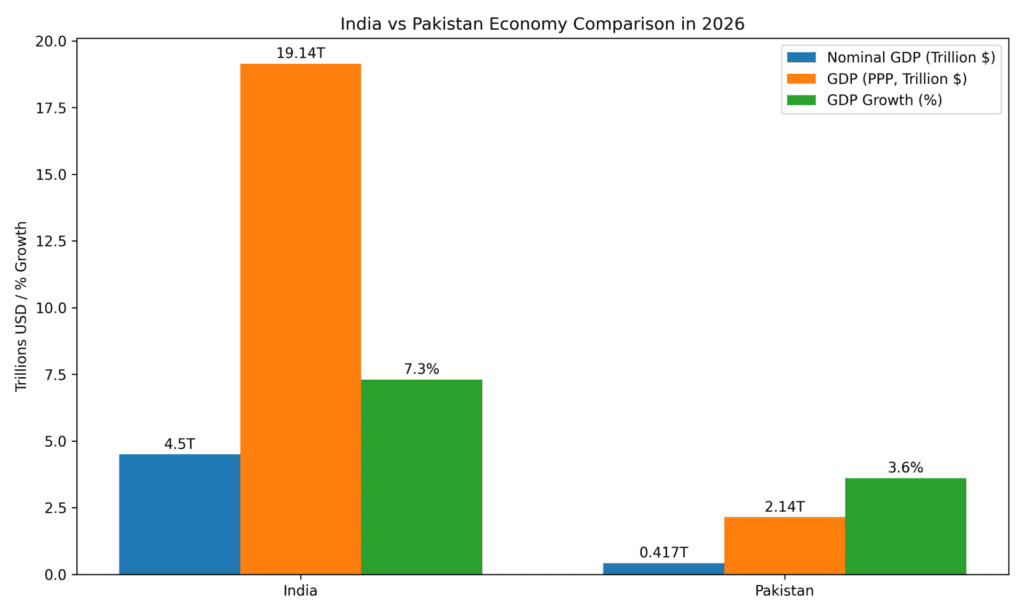
Talking about India and Pakistan’s economies, India’s nominal GDP would be 4.5 trillion dollars, while Pakistan’s would be 417 billion dollars, expectedly, in 2026. According to the International Monetary Fund (IMF) and a few other reports, India’s GDP in PPP (purchasing power parity) terms is forecast to be 19.14 trillion dollars. India is the 5th largest economy in nominal GDP, and the 3rd largest economy in PPP terms.
On the other hand, according to World Economics estimates, the GDP (PPP) of Pakistan would be 2.14 trillion dollars in 2026. GDP Growth Rate of India would be (forecast) 7.3%, while Pakistan’s 3.6% (forecast), at the end of the current fiscal year. Pakistan is the 41st largest economy in nominal GDP, and the 26th largest economy in PPP ( purchasing power parity). Another fact that is very important is that growth rate projections can vary in 2026 due to the Gulf War (Iran versus Israel-American War) situation.
2. Per Capita GDP Overview

The second most important figure, if we talk about India and Pakistan’s economies, according to the International Monetary Fund (IMF) and World Economic Outlook, the nominal GDP per capita of India is 2,818 dollars, and of Pakistan’s is 1707 dollars. The current population of India is 1.48 billion people, while Pakistan’s is more than 25 crores. Population-wise, India has surpassed China, and is one of the biggest countries with a huge population.
3. Debt Structure: Foreign & Domestic
Currently, India’s external debt (foreign debt), including government + corporates + banks + other institutions, is 746 billion dollars, around. With an exchange rate of ₹82 = $1 USD, in Indian rupee it is ₹61.23 lakh crore. It is approximately 16.6 % of GDP. On the other hand, Pakistan’s external debt is estimated at around 130 billion dollars.
Internal debt (domestic loan) of India is projected at ₹190 lakh crore (about 2.32 trillion dollars), if the exchange rate is considered ₹82 = $1 USD, nearly 51 % of GDP. While if we debate about Pakistan, during the discussion of India and Pakistan’s economies, then Pakistan’s internal (domestic loan) is roughly 60,861 billion rupees (60.86 trillion rupees) or in dollar footings 215 billion dollars (considering ₹82 = $1 USD), roughly.
The total public debt (foreign + domestic) of India is 3.07 trillion dollars, around 68 % of GDP. On the contrary, Pakistan’s total government debt in dollar terms is 345 billion dollars (130+215=345 billion dollars).
Note: – Above cited % of GDP related to Indian economy, are, if nominal GDP (national income) is 4.5 trillion dollars in 2026).
4. Exports, Imports, and Trade Dynamics
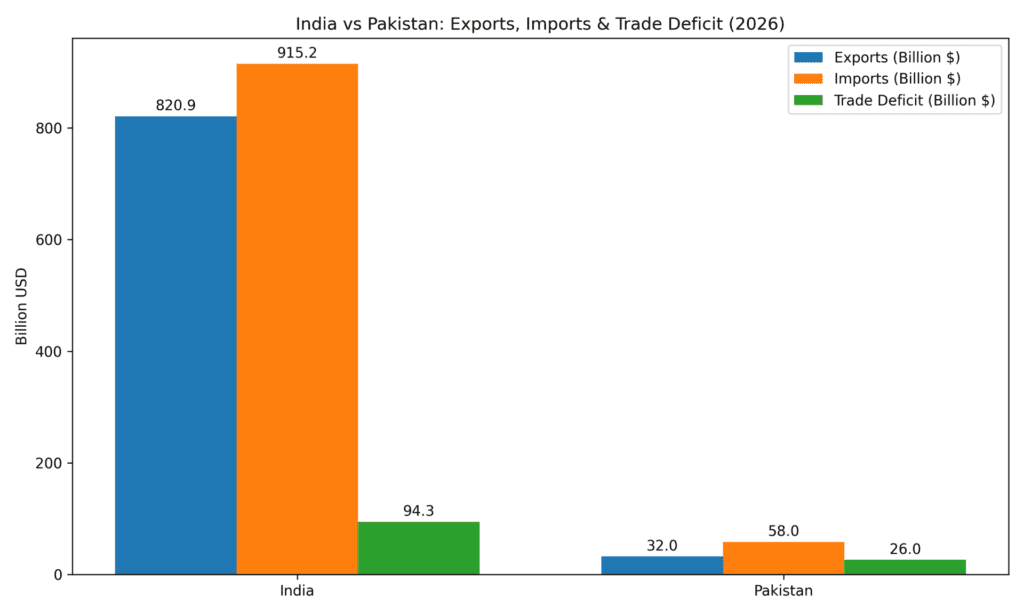
If I look at India and Pakistan’s economies, India’s exports are 820.9 billion dollars, mainly goods and services, while imports are 915.2 billion dollars. So India’s trade deficit stands at 94.3 billion dollars, around. Key export allies are the United States, the European Union, the United Arab Emirates, China, Hong Kong, Singapore, the United Kingdom, etc.
And key import allies are China, Hong Kong, Russia, the European Union, the UAE, the United States, Saudi Arabia, etc.
Pakistan’s exports stand at $32 billion, and imports at $58 billion, while its trade deficit is $26 billion. This trade deficit is enormous. Pakistan’s key export allies are China, the UAE, the United Kingdom, Germany, Spain, the Netherlands, the United States, Italy, etc. And key importing states are China, UAE, Saudi Arabia, Singapore, Indonesia, Kuwait, Russia, the U.S.A., etc.
5. Education and Literacy Indicators
While we are debating aboutIndia and Pakistan’s economies, it is important to take birds eye view of the literacy situation of India. With reference to the World Bank, literacy rate in India is 77–78% (15+ above). This depicts that around 3 out of 4 persons aged 15 and above can read and write sensibly.
Literacy rate in Pakistan is 63 %, which means that if an individual can read and write, around six out of ten people aged 10 or above, then those people will be considered literate.
6. Status of Employment
During the comparison of India and Pakistan’s economies, it is imperative to bring into discussion the sector of the job market. India’s national unemployment rate, as of December 2025, is around 4.8 %. This number shows the percentage of individuals aged 15 years and older than 15 years, who are dynamically in search of work but have no job. The entire labor force in India is 610 million persons (61crore). This represents persons aged 15–64 who either have a job or are actively looking for work.
With reference to India and Pakistan’s economies, if I discuss the job market in Pakistan, then this figure is 7.1 %. The overall labor force in Pakistan is 77 million persons (7 crore and 70 lakh).
7. Global Economic Standing
Their associations with global financial organizations are an unambiguous contrast. Pakistan’s economic management has been mostly shaped by repetitive IMF bailouts—Pakistan contacted the International Monetary Fund 24 times since 1958, most recently for a $7 billion program in 2024. India had not received any loan from the IMF since its momentous reforms in 1991.
India is a member of these worldwide organizations: the IMF, WTO, WCO, SAFTA, BIMSTEC, BRICS, G-20, BIS, AIIB, ADB, and others. Pakistan is also a member of many international organizations like the IMF, the World Bank, the WTO, the ADB, etc.
8. Poverty Situation Overview
While talking about the comparison of India and Pakistan’s economies, the topic of poverty is highly relevant to both economies. According to the World Bank and official assessments, around 13–14% of India’s individuals live below the state poverty line in 2025–26. In absolute terms, this is around 180–190 million people remaining in poverty.
According to international poverty criteria of $4.20/day (PPP), 23.9 % of India’s people live below the poverty line. This makes 342 million people (34 crore and 20 lakh), 2022–23 data.
In Pakistan, according to the state poverty line, 25 % individuals fall under to poverty line. Around 65 million (6 crore and 50 lakh) Pakistanis are assessed to be poor under the national poverty criteria.
While with reference to the International Poverty criteria recommended by the World Bank, for lower‑middle‑income economies, this International Poverty Line is $4.20/day per individual. According to this measure, 44.7 % persons are poor, and 10.8 million persons are living under poverty line. (10 Crore and 80 lakh people).
9. International Reserves
While comparingIndia and Pakistan’s economies in 2026, another vital data point, foreign exchange reserves, has a key placement in both economies. India’s forex reserves reached a best-ever height of 723.8 billion dollars, as of January 30, 2026, according to the Reserve Bank of India. These reserves are sufficient for over 11 months of importation.
Whereas, as of January 2026, the entire liquid foreign exchange reserves of Pakistan are 21.2 billion dollars.
10. Foreign Direct Investment Trends
Foreign direct investment of around 81.04 billion dollars flows to India in the fiscal year 2025-26. This data source is India’s Ministry of Commerce and Industry. The services sector was the principal recipient of this foreign direct investment. These gross FDI inflows are for the fiscal year 2024-25. (April 2024 to March 2025).
If I shed light on total FDI Inflows during fiscal year 2024–25, with reference to India and Pakistan’s economies comparison, then Pakistan received about 2.46 billion dollars in FDI from all overseas partners jointly.
11. Inflation Rate Analysis
During the discussion of India and Pakistan’s economies data, one element is very prominent to be highlighted, and that is inflation. Average CPI inflation for fiscal year2024-25 was around 4.6 %.
Whereas, Pakistan’s average inflation for the fiscal year 2024-25 was about 4.5 %, a significant reduction from around 23.4 % in fiscal year 2023-24.
12. Government Budget and Fiscal Health
Total income revenues(tax + non-tax) were about ₹30.36 lakh crore, and whole spendings were around ₹46.56 lakh crore, according to The Economic Times. Budget shortfall was around ₹15.77 lakh crore in absolute terms. Fiscal shortfall for fiscal year 2024-25 stood at almost 4.8 % of GDP.
Total revenue for the fiscal year 2024-25 was nearly 17.997 trillion PKR (15.7 % of GDP). Total spending was about 24.165 trillion PKR (21.1 % of GDP). The consequential budget shortfall (discrepancy) was 6.168 trillion PKR (5.38 % of GDP).
13. Remittances Status
India and Pakistan’s economies are imperative for getting the information about the foreign remittances of both states. India received the highest 135.46 billion dollars in remittances in fiscal year 2025, the largest amount of money sent back to India by Indians overseas.
Pakistan also received the greatest remittance of 38.3 billion dollars during the fiscal year 2024-25, more than 27 % from the previous year.
Conclusion
In conclusion, India and Pakistan’s economies in 2026 replicate conflicting growth paths and structural challenges. India shows strong GDP growth, determined by services and industrial development, while Pakistan is facing sluggish recovery due to fiscal and foreign pressures. Inflation, employment, poverty, trade, and budget-related figures highlight the different economic truths of both economies.
By investigating the newest facts and figures, it is obvious that policymakers in India and Pakistan must focus on economic growth, poverty reduction, reducing budget deficits, the job sector, and investment to strengthen their own economies.
About the Author
Shahzad Ahmad is an Assistant Professor of Economics and an economics writer specializing in macroeconomic and global economic trends.
He presents complex economic issues in a simple and clear way for students, researchers, and general readers.
Q. 1 How much remittances sent to India by overseas indians in 2025
Remittances of 135.46 billion dollars inflow to India
Q. 2 How much remittances sent to Pakistan by overseas Pakistanis in 2025
Remittances of 38.3 billion dollars inflow to Pakistan
Q. 3 What is budget deficit of India in 2024-25
Budget deficit of India in 2024-25 is 4.8 % of GDP
Q. 4 What is budget deficit of Pakistan in 2024-25
Budget deficit of Pakistan in 2024-25 is 5.38 % of GDP
Q. 5 How many people are poor in Pakistan in 2026
44.7 % persons are poor in Pakistan