Economic Indicators of Pakistan in 2026: A Comprehensive Analysis
Introduction
In this article, I will explain the economic indicators of Pakistan for 2026. Pakistan’s fiscal year starts from 1st of July and ends on June 30 of the next year. The current fiscal year of Pakistan started on 1st of July 2025 and will end on 30th June 2026. Most of the figures presented in this article refer to the last fiscal year (2024–2025) and the year 2026.
This video explains the economic indicators of Pakistan in 2026. What was the GDP of Pakistan last year, and projections for GDP and economic growth for 2026? Other facts, such as per capita income, inflation, unemployment, debt, FDI, foreign remittances, and fiscal situation, have been elaborated.
This video summarizes GDP, inflation, debt, and other key indicators of Pakistan’s economy.
1. Economic Output: Nominal GDP vs. PPP GDP
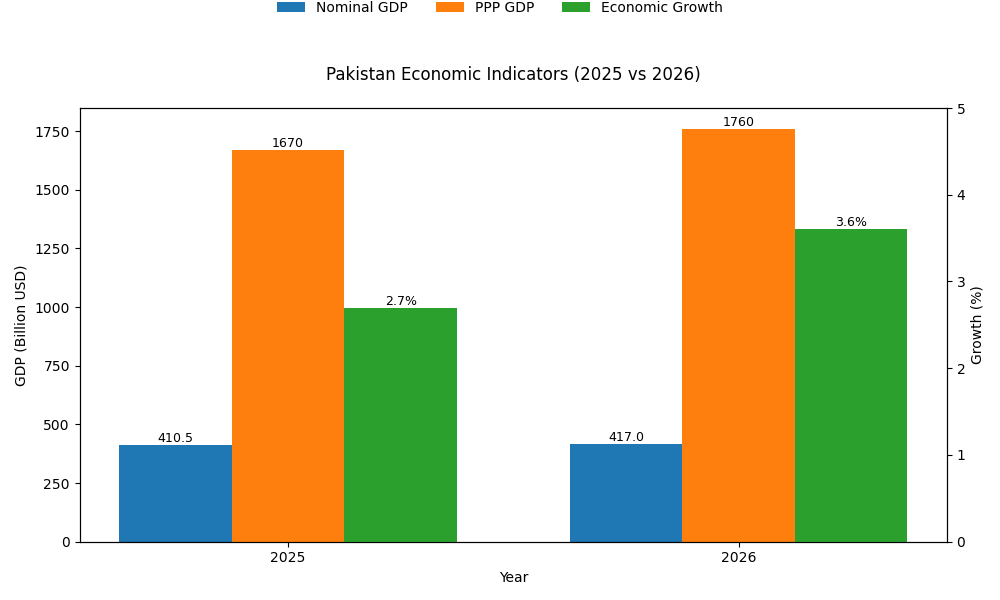
According to the IMF’s April 2026 World Economic Outlook, Pakistan’s economic growth is projected at around 3.6% for the fiscal year 2026 (FY2025-26), while the IMF’s estimation is 2.7% for fiscal year 2025 (FY2024-25).
The size of the economy, nominal GDP, plays a crucial role in any country. Pakistan’s nominal GDP is approximately 410.5 billion dollars in 2025, according to the IMF. For the year 2026, it is projected to exceed 417 billion dollars, according to Statista Research Department / IMF.
GDP is also measured in PPP (purchasing Power Parity) terms. It adjusts for price level differences across countries, so it shows how much goods and services people can actually buy in their own economy, while nominal GDP uses current market exchange rates to value an economy in US dollars. According to the IMF, PPP GDP was 1.67 trillion dollars in 2025. According to estimates based on the IMF and global economic outlook, in 2026, Pakistan’s GDP in PPP terms would be expected to be 1.76 trillion dollars.
2. GDP Per Capita
The second most important figure, if we talk about the economic indicators of Pakistan, is GDP per capita. According to the World Economic Outlook of the International Monetary Fund (IMF), the current GDP per capita (nominal) is 1,707 dollars per person. While the population of Pakistan is 259 million (25 crores, 90 lakh).
3. Contribution of Different Sectors to GDP
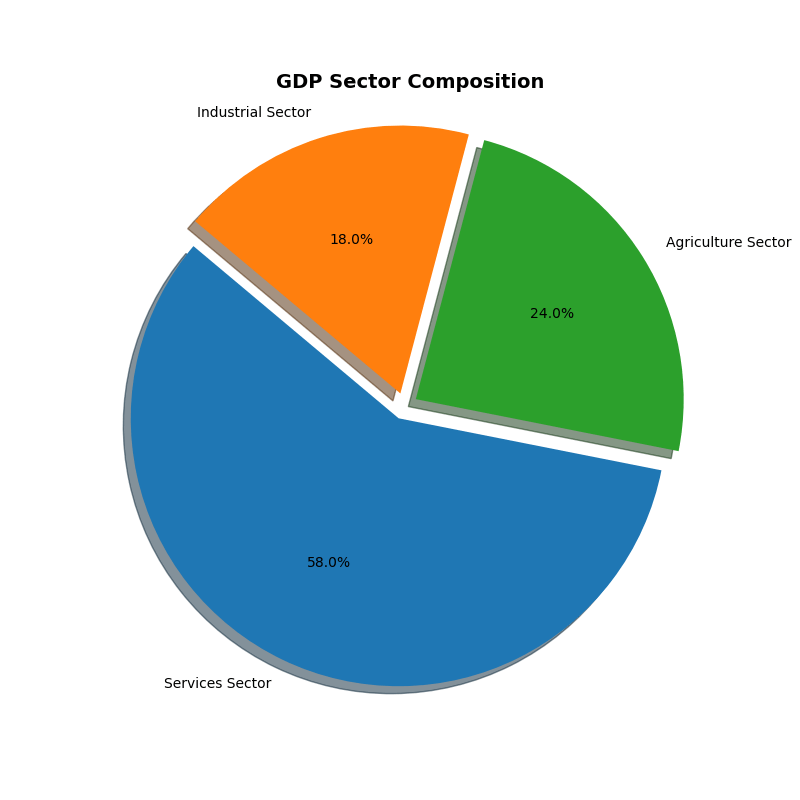
The services Sector is the biggest sector, contributing 58% to GDP, including trade, transport, communication, IT services, education, and healthcare, etc. The second biggest sector of the economy is the agriculture sector, its share is 24%, consists of wheat, rice, cotton, vegetables, fruits, forestry, and dairy, etc.
The third one is the Industrial sector, which contributes 18% to the national income of the country, and comprises the manufacturing of textiles & garments, construction, mining and quarrying, electricity, gas, and water supply, etc.
4. Inflation Trends and Price Stability
During the discussion of the economic indicators of Pakistan, one fact is very prominent to be highlighted, and that is inflation. This is disturbing the lives of the poor people, especially salaried persons and fixed-income people. According to data from the Pakistan Bureau of Statistics (PBS) and government sources, Pakistan’s average inflation for the fiscal year 2024-25 is about 4.5 %, a substantial decline from around 23.4 % in FY 2023-24. Now, in April 2026, the inflation rate in Pakistan has surged to 5.8 % due to the Gulf War situation.
According to the International Monetary Fund, as of its April 2026 World Economic Outlook, the inflation projection for Pakistan has been revised due to high energy costs and supply chain disruptions related to the Middle East conflict. The inflation rate projection for Pakistan is 7.2% for the current fiscal year of 2026.
5. Foreign and Domestic Loan Scenario
Pakistan’s external debt & liabilities are estimated at around 138 billion dollars, while domestic debt is 203 billion dollars (according to the market exchange rate, if considered 1 USD = 280 PKR), roughly. In Pakistani rupee domestic loan is 56.68 trillion rupees. In this way, the total debt of Pakistan in dollar terms is 341 billion dollars (138+203=341 billion dollars). On the other hand, the total public/Govt debt of Pakistan is 295.9 billion dollars (92.9 billion dollars + 203 billion dollars), where 92.9 billion dollars is Pakistan’s foreign public debt out of 138 billion dollars, remaining 45.1 billion dollars (138 – 92.9 = 45.1) belongs to other categories.
6. Trade Sector (Exports & Imports)
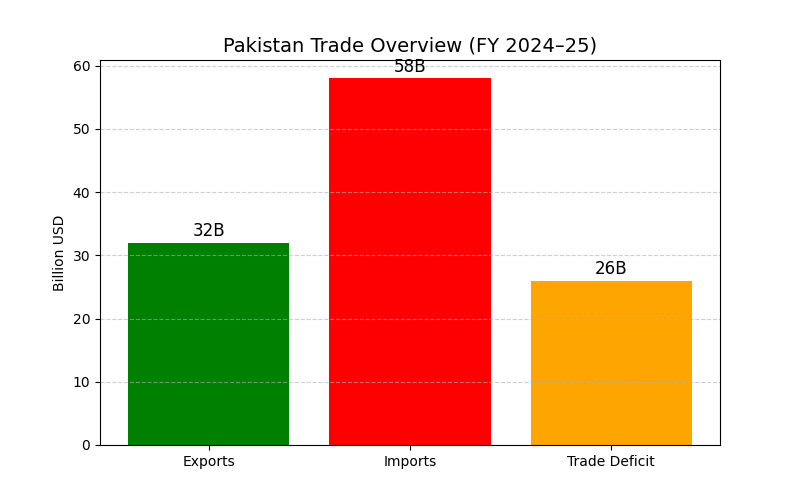
When talking about Pakistan’s trade sector in the context of economic indicators of Pakistan, then exports of Pakistan are 32 billion dollars for the fiscal year 2024-2025, while imports are 58 billion dollars, and Pakistan is facing a trade deficit of 26 billion dollars. This trade deficit is huge.
7. Employment Situation
With reference to the economic Indicators of Pakistan, if I discuss the employment situation, then the unemployment rate in Pakistan is 7.1 %, reported by the Pakistan Bureau of Statistics (PBS) from the Labor Force Survey 2024–25. According to the Pakistan Bureau of Statistics, the total labor force in Pakistan is 77 million people (7 crore and 70 lakh).
According to the IMF’s April 2026 report, the unemployment rate is projected to decrease from 7.1% to 6.9% for the current fiscal year of 2026.
8. Poverty Situation
Poverty issue falls in one of the major economic indicators of Pakistan. The living standard of most of the People of Pakistan is very low, and they are facing severe poverty due to inflation, economic shocks, and natural disasters.
According to the national poverty line, 25 % people fall below the poverty line. About 65 million (6 crore and 50 lakh) Pakistanis are estimated to be poor under the official national poverty measure.
While, According to International Poverty Measures suggested by the World Bank, for lower‑middle‑income countries, this Global Poverty Line is $4.20/day per person. According to this criterion, 44.7 % people are poor, and 10.8 million people are living below the poverty line. (10 Crore and 80 lakh people).
9. Foreign Exchange Reserves
Another significant figure, if we talk about the economic Indicators of Pakistan, is Foreign Exchange Reserves. In January 2026, total liquid foreign exchange reserves were 21.2 billion dollars. This comprises reserves held by the central bank and commercial banks combined.
State Bank of Pakistan’s reserves are 16.09 billion dollars, a portion of the reserves directly controlled by the central bank. Commercial banks have around 5.1 billion dollars in net foreign assets. In this way, the total liquid reserves are 21.2 billion dollars.
10. FDI (Foreign Direct Investment)
If I shed light on total FDI Inflows during fiscal year 2024–25, with reference to economic indicators of Pakistan, then Pakistan received about 2.46 billion dollars in FDI from all foreign partners collectively. Approximately 50% of that FDI came from China, making it the main single investor, followed by Hong Kong, the UAE, Switzerland, the UK, and South Korea, etc.
11. Fiscal Position of the Government
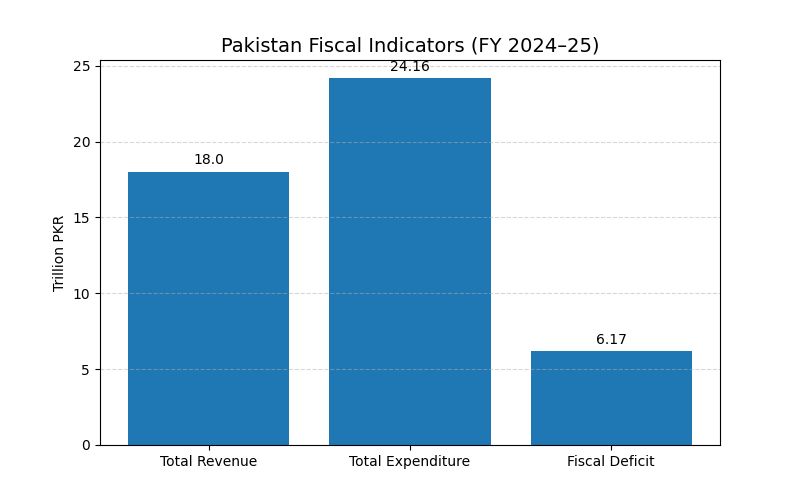
Another noteworthy indicator of the economy of Pakistan is the fiscal Deficit, which is related to total revenues and total expenditures of the country. For the fiscal year 2024-25, the total revenue was about 17.997 trillion PKR (15.7 % of GDP). Total expenditure was about 24.165 trillion PKR (21.1 % of GDP). The resulting budget shortfall (deficit) was 6.168 trillion PKR (5.38 % of GDP).
12. International Worker Remittances
Pakistan received a record remittance of 38.3 billion dollars during the fiscal year 2024-25 (July 2024–June 2025), more than 27 % from the previous year. This was the highest annual remittance level in the country’s history, driven by strong overseas worker flows and supportive policies that expanded formal transfer channels.
Keeping in mind the economic indicators of Pakistan, experts and market reports suggest Pakistan is targeting around $41 billion in remittances during the fiscal year 2025-26. The biggest remittances sender countries included Saudi Arabia, United Arab Emirates (UAE), United Kingdom, United States, Other contributors: Oman, Qatar, Italy, Spain, Canada, Australia, etc. In the coming times, foreign remittances can be affected due to the Iran-USA-Israel War.
Conclusion
After analyzing the major economic indicators of Pakistan, we can conclude that Pakistan’s economy is stabilizing but remains structurally weak. On the encouraging side, inflation has fallen suddenly in 2024–25, the current account has improved, and foreign remittances are at high levels, providing backing to foreign exchange reserves. These factors have condensed immediate macroeconomic stress and upgraded short-term stability. Some structural problems are still present, like a low savings rate (7 to 8 % of GDP), fiscal deficit, trade deficit, poverty, unemployment, etc.
Pakistan is out of crisis mode but not out of distress, because again the inflation rate has increased due to the Gulf Crisis. The economy is persisting on remittances, foreign support, and tight strategies, instead of strong domestic output. Pakistan’s economy can be boosted if we increase savings, exports, tax collection, and productivity.
About the Author
Shahzad Ahmad is an Assistant Professor of Economics and an economics writer specializing in macroeconomic and global economic trends.
He presents complex economic issues in a simple and clear way for students, researchers, and general readers.
Q-1 How much is the nominal GDP of Pakistan for the fiscal year 2024-25
Nominal GDP of Pakistan for the fiscal year 2024-25 is 410 billion dollars
Q-2 What will be the nominal GDP of Pakistan in 2026
Nominal GDP of Pakistan in 2026 would be expectedly 417 billion dollars
Q-3 How much is per capita income of Pakistan for the fiscal year 2024-25
Per capita income of Pakistan for the fiscal year 2024-25 is 1707 dollars
Q-4 How much are foreign exchange reserves of Pakistan in 2026
Foreign exchange reserves of Pakistan in 2026 are 21.2 billion dollars.
Q-5 What is the unemployment rate in Pakistan for the fiscal year 2024-25
Unemployment rate in Pakistan is 7.1 %, for 2024-25