Iran vs Pakistan Economy 2026: GDP, Inflation & IMF Forecast
Introduction
The Islamic Republic of Iran and Pakistan are two neighboring countries that are located geographically in a very important place in South Asia. The Iran vs Pakistan economy 2026 comparison is important and justifiable because both are Muslim countries and have the same ideology based on Islam. In spite of these similarities, both economies have different economic situations. Inflation and GDP scenarios of both countries are conflicting, especially nowadays.
Iran’s economy is rich in oil & gas and mostly dependent on its own resources, along with facing economic and financial sanctions for the last few decades, while Pakistan’s economy is diversified and is heavily reliant on foreign resources and external loans.
According to the International Monetary Fund’s analysis, Iran’s economy is on a declining path; due to the War situation, on the other hand, Pakistan’s is economically growing but at a slow pace.
Iran and Pakistan are important states in the region of South Asia because Iran controls a part of the Strait of Hormuz, through which a large segment of the world’s oil exports pass. Iran influences regional and international politics via its connections with the Middle Eastern states.
Pakistan is the only nuclear state in the Muslim world and has a strong defense capability in this region. Pakistan’s strong relations with China, especially through CPEC, make it more vital in the region.
Economic Growth Rate Comparison: Iran vs Pakistan in 2026
The real economic growth rate of Iran for the year 2026 is -6.1 percent, while Pakistan’s is 3.6 percent. On the other hand, Iran’s real GDP growth rate was -1.5% in 2025, while Pakistan’s real GDP growth rate was 3.1% in the same period. These are the IMF estimates for 2025 and forecasts for 2026, for both economies, when we are discussing the Iran vs Pakistan economy 2026.
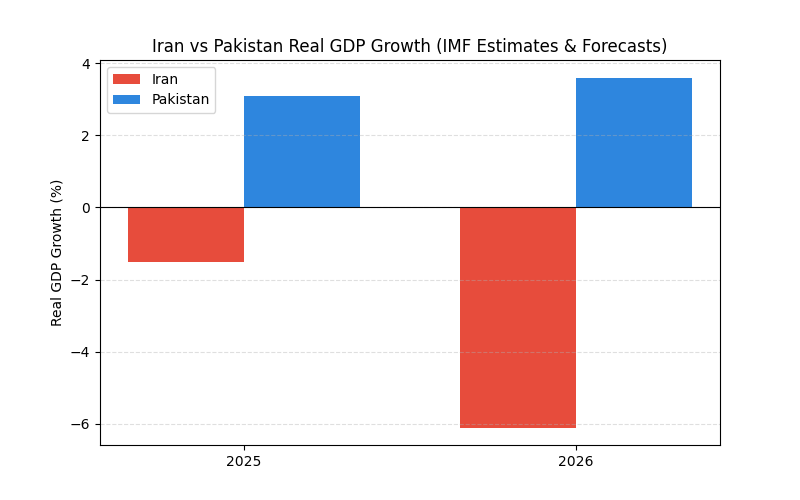
Iran’s economy will shrink in 2026 due to the war, the oil trade blockade, and heavy sanctions, while Pakistan’s economy will not grow significantly due to structural factors. The year 2025 was better for Iran because there was no war, although there were many economic troubles.
Iran vs Pakistan GDP in 2026: A Comprehensive Economic Comparison
The nominal GDP for Iran in 2026 is forecasted at $300 billion, while that of Pakistan is at $452.1 billion. Estimates for Iran’s GDP for 2025 are $371 billion; on the other hand, for Pakistan, it is $407.79 billion, reported by the International Monetary Fund, while we are analyzing the Iran vs Pakistan economy 2026 comparison.
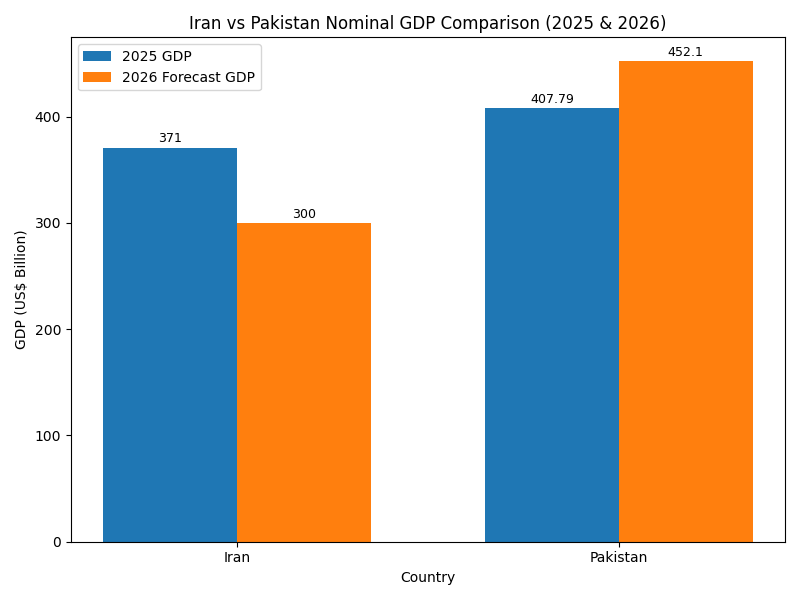
Talking about GDP at Purchasing Price Parity, the GDP (PPP) of Iran for 2026 is $1.78 trillion, and for 2025 it is $1.85 trillion, whereas Pakistan’s would be 1.67 trillion dollars and 1.8 trillion dollars for the same period, respectively. These are forecasts for 2026 and estimates for 2025 by the IMF for both countries, Iran and Pakistan, except Pakistan’s current GDP of $452.1 billion & GDP at PPP of $1.8 trillion (this figure is designated by the government of Pakistan).
As GDP (Gross Domestic Product) shows the total value of goods and services produced in a country within its geographical boundaries within a specific time period, generally one year. When it is calculated on current prices, it is called nominal GDP; on the other hand, if we see how much people have purchasing capacity and price levels are involved, then it is called GDP at purchasing price parity.
Comparing Inflation Rates in Iran and Pakistan in 2026
In Iran, the inflation situation is very bad, and inflation is increasing day by day.Iran vs Pakistan economy 2026 forecast depicts that consumer price inflation in Iran is expected to reach around 68.9% (baseline projection) for the 2026 calendar year. But in a worse scenario, if the conflict lingers on and leads to extended energy supply interruptions or the closure of the Strait of Hormuz, inflation could intensify by over 75%.
In Iran, inflation is due to the War and geopolitical shocks, currency depreciation, fewer exports, less & expensive imports, supply chain blockades, continuous economic and financial restrictions, etc.
Contrary to the reasons for inflation in Iran, Pakistan is facing high prices due to political instability, elite capture, corruption, budget & trade deficits, inconsistent policies, structural issues, low agricultural and industrial productivity, etc.
Currency and Exchange Rate Issues in Iran and Pakistan
Iran has a worse scenario of currency depreciation, as in the open market. One United States dollar is equal to 1,890,000 old rials, approximately. So, the Iranian government has issued a new currency component that is equal to 10,000 old rials. It shows that one new rial is equivalent to 10,000 old rials. Creation of a new rial is for psychological reasons and relaxed day-to-day transactions.
Iran’s worst currency situation is due to economic and financial sanctions over the last few decades, and especially restrictions on imports and exports.
On the other hand, Pakistan’s currency, PAK Rs, is also weak, but not as weak as Iran’s. In comparison to the US dollar, one Pakistani rupee is equal to roughly 279 to 280 rupees in the open market.
Pakistani currency is weak due to a lack of foreign exchange reserves, a chronic trade deficit (fewer exports, low-value exports, & high imports, especially non-productive imports), a high burden of repayment of loans with interest, low productivity, and political instability, contributing to the lower value of the currency compared to other currencies.
Iran and Pakistan Debt Profile 2026: Internal vs External Borrowing
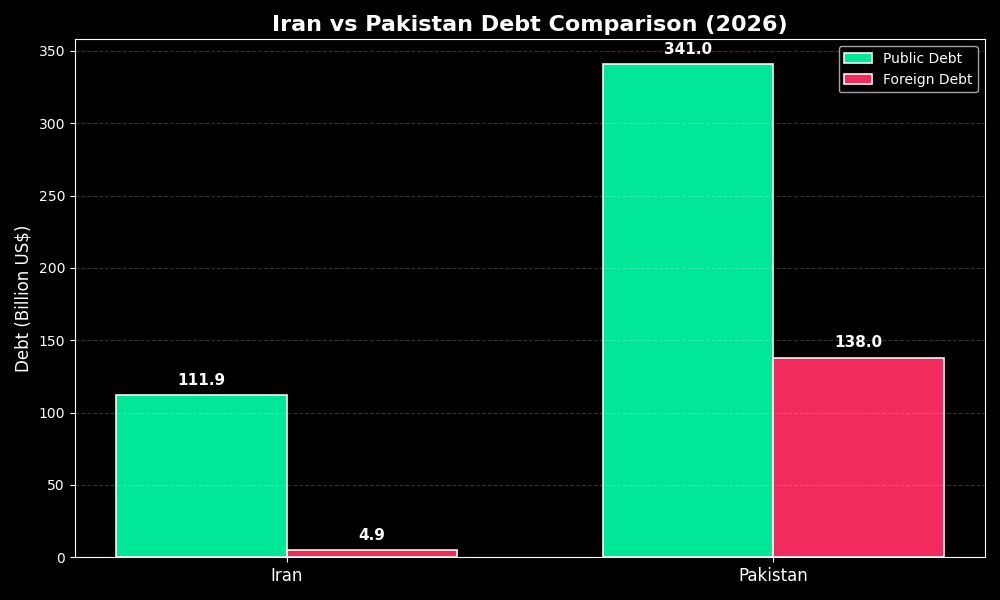
The Iran vs Pakistan economy 2026 analysis shows that the debt scenario of both economies is different. The total public debt of Iran stands at $111.9 billion, which is 37.3% of GDP for the year 2026, while Pakistan’s is nearly $341 billion (83% of GDP). Here, Pakistan’s figure is more than twice that of Iran’s. Pakistan has a heavy burden of debt relative to its GDP. Iran’s dependence on loans is lower in comparison to its GDP.
The foreign debt of Iran is merely $4.86 billion, which makes up 1.62% of GDP; on the other hand, Pakistan’s is $138 billion. Iran’s external debt is many times lower than Pakistan’s. Iran’s external debt is lower due to economic and financial sanctions, and the IMF and the World Bank are highly restricted from giving loans to Iran. Most of the portion of foreign debt is consisted upon loans given by China and Russia.
The economy of Pakistan heavily relies on foreign resources (foreign debt) because the country has less revenue from exports, taxes, and non-tax sources, and is facing a shortfall of revenues due to political instability, elite capture, corruption, high imports, energy crisis, high cost of gas and electricity, especially for manufacturers, and high non-developmental government expenditures.
The public domestic debt of Iran stands at approximately $107 billion, whereas Pakistan’s is near $203 billion. Both economies have gotten loans from their central banks, commercial banks, and from the public by issuing bonds.
Comparing Foreign Exchange Reserves in Iran and Pakistan
Iran’s total foreign exchange reserves are more than $134 billion. Among these, $33.8 billion is in the custody of the central bank (usable, less than $10 billion, plus unusable $23.8 billion), while Iran’s internally frozen assets remain at roughly $100 billion.
While Pakistan’s foreign exchange reserves stand at more than $22 billion. This encompasses reserves held by the central bank and commercial banks combined. The reserves, which are in the custody of the State Bank of Pakistan, are more than $17 billion, a portion of the reserves directly controlled by the central bank.
Commercial banks have around $5 billion in net foreign assets. Among $22 billion, approximately $9 billion can be fully used by the government of Pakistan. This information is as of the IMF.
In a nutshell, the Iran vs Pakistan Economy 2026 comparison depicts that both countries’ usable forex stands at roughly $9 billion. This similarity of figures is a coincidence.
Comparing Iran and Pakistan’s Per Capita Income
Iran vs Pakistan economy 2026 evaluation shows that Iran is an upper-middle-income country, and its per capita income is $4,250 annually. Whereas Pakistan is a low-middle-income country, and its per capita income is approximately three times lower than that of Iran, which stands at $1707, stated by the International Monetary Fund.
Per capita income is gained by dividing GDP by population. The population of Iran is 92 million, as compared to Pakistan’s population of 258 million. Nominal GDP of Iran currently sits at $371 billion as compared to Pakistan’s $410 billion.
Iran vs Pakistan Trade Analysis 2026: Exports, Imports, and Key Sectors
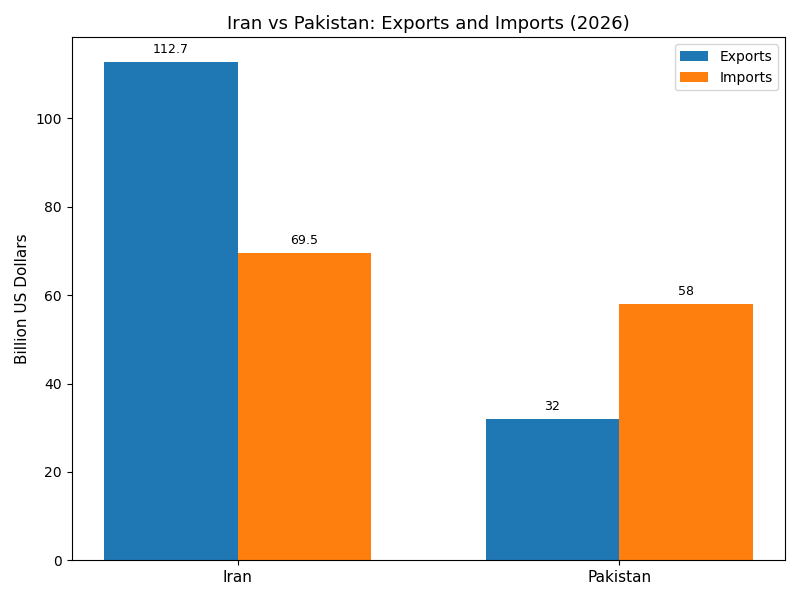
The Iran vs Pakistan economy 2026 comparison reveals that, according to the latest available data from the IMF, exports of Iran are $112.7 billion, whereas Pakistan’s remain at $32 billion. Iran is an oil and gas-producing country and exports oil, gas, and petrochemicals, while Pakistan is agriculture economy and exports majorly textile related items, rice, sugar, and wheat, etc.
Imports of Iran stand at around $69.5 billion; however, imports of Pakistan are $58 billion. Here, there is a slight difference between the import figures of both countries. Both countries import basic needs items, machinery, cars, electronics, etc.
Iran has a trade surplus of $43.2 billion, in contrast to Pakistan, which is facing a trade deficit of $26 billion. Instead of global economic and financial sanctions, Iran’s exports are more than its imports, which is why it has a trade surplus.
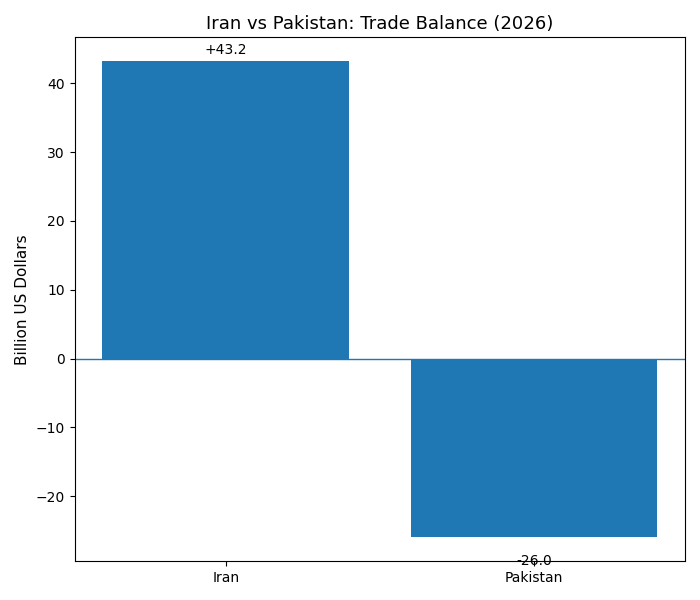
Pakistan’s exports are lower due to structural issues, political instability, shortage and expensive energy, high cost of production, reliance mostly on basic agricultural items, etc. Ultimately, exports are lower, and imports are high due to the use of luxurious items, oil importation, machinery, and vehicles, etc. So, Pakistan is facing a huge trade deficit.
Poverty Scenario in Iran and Pakistan (2026 Comparison)
The Iran vs Pakistan Economy 2026 assessment exposes that in Iran, 38.8% (around 34 to 35 million) of the population is estimated to live below the poverty line. Whereas in Pakistan, 44.7% of people are poor (10 Crore and 80 lakh people), according to the criterion defined by the World Bank, as reported by the IMF.
In Iran, the poverty level is high because of high inflation, constant sanctions for a long time, fewer imports, and a few other factors that are also contributing to this poverty. Due to the war situation, poverty can increase further.
In Pakistan, political instability, corruption, budget deficit, trade deficit, high prices, and agricultural and industrial backwardness contribute a lot to enhancing poverty for low and middle-income people.
Iran vs Pakistan Unemployment Trends and Forecast (2026)
The unemployment rate in Iran is projected at 9.2%, while it was 9.5% in 2025, according to the IMF. On the contrary, in Pakistan, it sits at 7.1 % in 2025, reported by the Pakistan Bureau of Statistics (PBS) from the Labor Force Survey 2024–25. This unemployment comparison highlights an important aspect of the economic analysis in the Iran vs Pakistan economy 2026.
Here, it is imperative to mention that the 9.2% figure means that out of 100 people who are able to work and willing to work, around 9 people are unable to get jobs or are unemployed.
The above-mentioned data shows that in Iran, the unemployment rate is high compared with Pakistan. These jobless people are due to the war situation in Iran, and multiple years of economic and financial sanctions are contributing a lot. While in Pakistan, joblessness is due to political instability, less growth in the industrial sector, structural issues, and a lack of technical education, etc.
Further analysis of job markets in both economies shows that the labor force of Iran stands at around 29.5 million people out of the total population of 93.17 million,based on estimates as of early 2026. Around 26.7 million people are employed, while 2.8 million people are jobless, reported by the IMF.
In contrast to Iran, Pakistan’s total labor force, according to the Pakistan Bureau of Statistics, is 77 million, which accounts for 7 crore and 70 lakh people in a population of 25.8 million.
Iran vs Pakistan: Sector-Wise GDP Contribution 2026
The analysis of the Iran vs Pakistan economy 2026 shows that, according to the IMF and the World Bank reports, the Iranian services sector has a 51% contribution to the country’s GDP, as compared to Pakistan’s 58% share in this sector. These services in Iran comprise retail trade, transportation, telecommunications, public administration, education, healthcare, and real estate.
While Pakistan’s services sector includes import & export trading, road transport, railways, air transport, finance & insurance, information and communication, hospitality and tourism, etc.
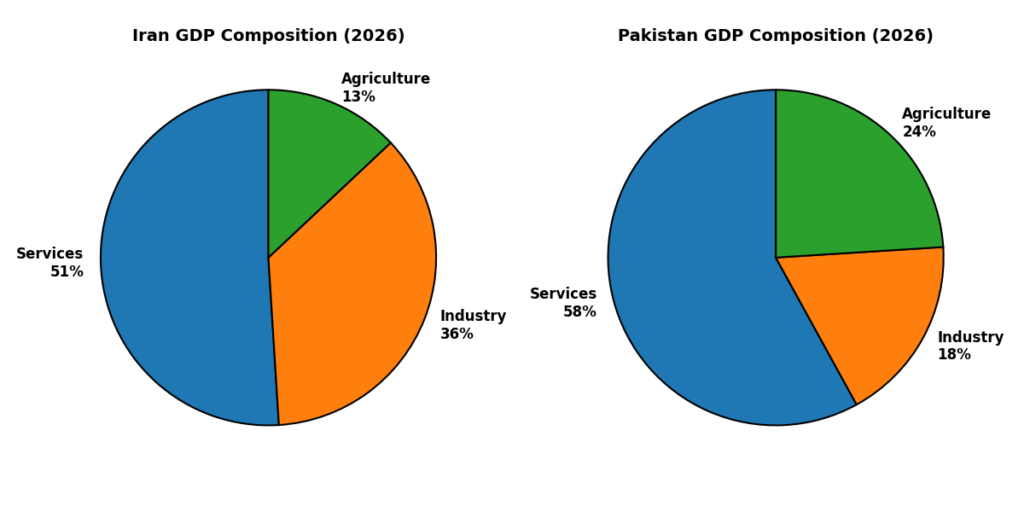
The second-largest segment of the Iranian economy is the industrial sector, which has a 36% share in GDP, in contrast to Pakistan, which has an involvement of 18% in GDP. Iran’s industrial sector comprises four subsectors: manufacturing, mining, construction, and public utilities (electricity, water, and gas). Automotive production, Metals formulation, Petrochemicals, food processing, Pharmaceuticals, and textiles are produced or processed in the manufacturing (sub-sector).
Extraction of crude oil and natural gas, digging and extraction of iron ore, copper, zinc, and lead fall in the category of mining (sub-sector). Mega projects, including dams, tunnels, highways, and national rail networks, lie in the construction sector (sub-sector). The fourth subsector of Utilities covers Power & distribution, such asgas, hydroelectric power plants, gas pipelines, water treatment, and electrical transmission, etc.
Pakistan’s industrial sector includes textiles, apparel, home linens, sports goods, surgical instruments, and foreign-brand assembly plants, when we are discussing the Iran vs Pakistan economy 2026 comparison.
The Iran vs Pakistan economy 2026 comparison reflects that Iran’s agriculture has a 13% contribution to national income; on the other hand, Pakistan’s agriculture sector has a 24% share in GDP. Iran is a major cultivator of wheat, barley, rice, pistachios, dates, saffron, and sugar beets, while in Pakistan, the crops of wheat, rice, cotton, fruit, fisheries, and the dairy industry play a prominent role.
Iran vs Pakistan FDI Outlook 2026
FDI (inflows) to Iran are around $1.45 billion according to the existing data for 2024. As a percentage of GDP, it is about 0.33% (2024). While in Pakistan, foreign direct investment (inflows) stands at about 2.46 billion dollars for fiscal year 2024–25 from other countries of the world. It is FDI from all foreign partners collectively.
Russia, China, the UAE, Turkey, and India have invested heavily in Iran; on the other hand, China, Hong Kong, the UAE, Switzerland, the UK, and South Korea, etc. have invested in Pakistan. China alone has roughly a fifty percent share of investment in Pakistan.
The investigation of the Iran vs Pakistan economy 2026 comparison shows that foreign countries have invested in Iran in the sectors of oil & gas, mining, petrochemicals, food processing, automotive, and pharmaceuticals. Whilst in Pakistan, investment is in the banking & financial sector, energy, information technology, logistics, agriculture, and the petroleum exploration sector.
Fiscal Health of Iran and Pakistan: IMF Budget Forecast 2026
Iran’s current fiscal year starts on March 21, 2026, and ends on March 20, 2027. The Federal budget estimates show that the overall budget deficit of Iran is expected to be 5.2% of GDP. Whereas the current fiscal year of Pakistan starts on 1st July 2025 and ends on 30th June 2026. The resulting budget shortfall (deficit) of Pakistan is expected to stand at 3.6% to 3.9% of the gross domestic product (GDP).
The Iran vs Pakistan economy 2026 comparison discloses that both economies have more expenditures than incomes, but Iran has a larger fiscal deficit than Pakistan. Iran will face more fiscal deficit, it has a logic, because the country is in a state of War with the USA.
Conclusion
The Iran vs Pakistan economy 2026 comparison concludes that currently Iran’s economy size is smaller than Pakistan’s, when we see Iran’s GDP at $300 billion, while Pakistan’s is around $452 billion (forecast). This means Iran’s economic growth is expected to be -6.1 % as compared to Pakistan’s 3.6% growth rate.
Due to the war in Iran, there is severe inflation of 68.9%, whereas in Pakistan, it is comparatively low; its forecast for 2026 is 7.2%, according to the IMF. Pakistan’s public is facing severe poverty, though in Iran poverty is growing due to the war conflict with the USA.
The strength of Iran’s economy lies in its huge resources of oil & gas, its strategic geographic location, skilled and educated workforce, and economic resilience, while Pakistan’s strength lies in its large young population, strong agricultural & textile sector, strategic location, large home market of more than 240 million people, and remittances from overseas Pakistanis.
Iran’s major challenges are economic sanctions, high inflation, high dependence on oil, currency depreciation, slow growth with high unemployment, and Geopolitical tensions. At the same time, Pakistan is facing budget deficits, trade deficits, inflation, energy shortages, low foreign exchange reserves, and Political instability, according to the Iran vs Pakistan economy 2026 comparison.
Q. What is the economic growth forecast for Iran and Pakistan in the Iran vs Pakistan economy 2026 comparison
The economic growth forecast for Iran is -6.1 % while Pakistan’s is 3.6% in the Iran vs Pakistan economy 2026 comparison
Q. Which economy is growing faster in 2026: Iran or Pakistan?
Pakistan’s economy is growing faster than Iran’s, because Pakistan’s forecasted economic growth rate is 3.6%, while Iran’s is -6.1 %
Q. What is the Iran vs Pakistan economy 2026 comparison in terms of GDP?
In the Iran vs Pakistan economy 2026 comparison, Pakistan’s nominal GDP is $452 billion, while Iran’s is $300 billion.
Q. What does the IMF say about Iran vs Pakistan economy 2026?
About the Iran vs Pakistan economy 2026, the IMF says that Pakistan will get loans from the IMF in the coming years, while Iran has restrictions related to the IMF.
Q. Which country has high inflation in Iran vs Pakistan economy 2026?
In the Iran vs Pakistan economy 2026, Iran has high inflation of more than 60 %, on the other hand, Pakistan has an inflation rate of 8 to 10%.
Q. What is the foreign debt situation in Iran vs Pakistan economy 2026?
In the Iran vs Pakistan economy 2026, Pakistan’s foreign debt is $138 billion, while Iran has very little foreign debt of $4.86 billion compared to Pakistan.
Q. What is the biggest challenge in Iran vs Pakistan economy 2026?
Talking about Iran vs Pakistan economy 2026, Iran is at war and facing economic and financial sanctions, but is facing a trade deficit, budget deficit, IMF conditions, and debt servicing issues such as high interest repayment on its debt.
Q. Which is the main economic sector in Iran vs Pakistan economy 2026?
In the Iran vs Pakistan economy 2026, Iran’s major sector is oil and gas, while Pakistan depends upon textile and agriculture
Q. Which country has better long-term economic potential in Iran vs Pakistan economy 2026?
In the Iran vs Pakistan economy 2026, Pakistan has a large youth population, contrary to this, Iran has huge oil & gas reserves and global integration