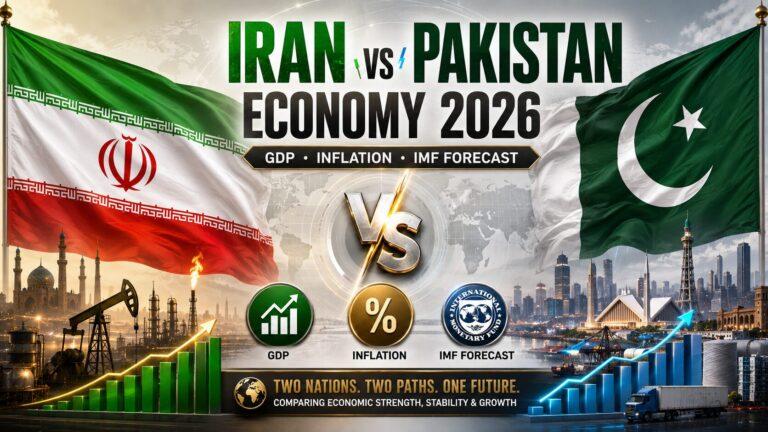
Iran Economic Outlook IMF 2026 Forecast
Introduction
The economy of the Islamic Republic of Iran is among the most multifaceted in the world, particularly in the Middle East. This is an Islamic state among 57 Muslim countries in the World. Iran has many natural resources, such as oil and gas. The country has considerable resilience, despite facing global sanctions for the last 47 years. Iran has proved its defense resilience during the current situation of War with the US and Israel, because the country is surviving with a limited economy, and financial & economic international sanctions.
In this article, it will be analysed how the Iranian economy is performing in areas of economic growth rate, nominal GDP, GDP at PPP, inflation, unemployment, per capita income, debt, FDI, foreign exchange reserves, poverty, international trade, and federal budget, based on IMF estimates. The Iran Economic Outlook IMF 2026 Forecast has been highlighted too.
Economic Growth in Iran: IMF 2026 Forecast Overview
The Iran Economic Outlook IMF 2026 Forecast shows that Iran’s real economic growth rate is projected to remain around -6.1% in 2026, showing a full-year economic slowdown, while, as of IMF estimates, its real GDP growth rate is -1.5% in 2025. This is according to the IMF’s April 2026 World Economic Outlook. But the Gulf War situation will further decide the scenario.
Iran’s Nominal GDP in the IMF 2026 Forecast
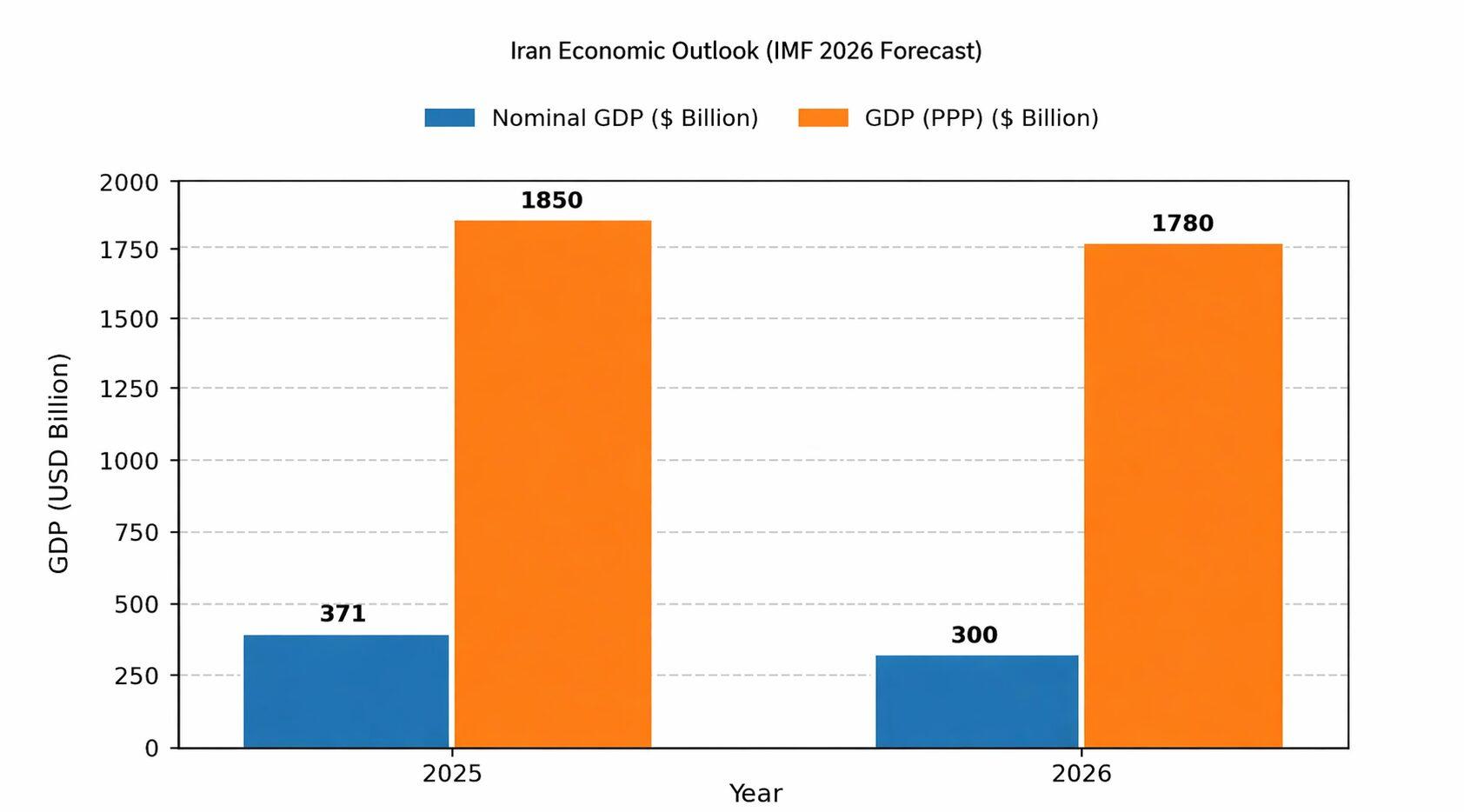
The Iran Economic Outlook IMF 2026 Forecast elaborates that the nominal GDP of Iran in 2025 is estimated at $371 billion, and GDP at purchasing power parity is at $1.85 trillion. Iran’s nominal GDP forecast for 2026 is at $300 billion, while GDP at PPP is at $1.78 trillion.
GDP shows the total production of goods and services produced within the geographical boundaries of a country over one year.
Inflation Challenges for Households and Businesses in Iran
The Iran Economic Outlook IMF 2026 Forecast depicts that consumer price inflation in Iran is expected to reach around at 68.9% (baseline projection) for the 2026 calendar year. But in a severe scenario, if the conflict continues and leads to extended energy supply interruptions or the closure of the Strait of Hormuz, inflation could increase by over 75%.
It refers to the average annual CPI inflation rate. This signifies a substantial increase from 40.7% in 2023, 31.7% in 2024, and 50.9% estimated for 2025. By observing monthly, inflation in March was 73.5%.
This high inflation rate is due to weak currency (rial depreciation), economic sanctions, supply constraints, higher energy and import costs, and recent geopolitical tensions, adding further inflation. Moreover, the Iran-Israel-US war situation will decide the inflation scenario further.
Besides these, the petrol price in Iran for Iranian citizens is very low. Petrol price is only 15000 rials for those consumers who consume up to 60 litres monthly. Those who utilize more petrol monthly, the price of petrol increases gradually, even then, it is very cheap. Because the Iranian government gives a heavy subsidy of approximatelly 90%, although its refining and transportation costs are very high. This is the information of May 15, 2026.
Currency Issues
Iran is facing severe issues of currency depreciation, such as one USD is equal to 1,895,500 old rials in the open market. Due to severe currency depreciation, the Iranian government has issued a new currency unit that is equal to 10,000 old units. Mean, one new rial is equal to 10,000 old rials. This has been done for easy transactions and for psychological reasons.
So, due to the new currency unit, one USD is equal to 189 new Iranian rials in the open market. While official rate is not so high.
Iran’s currency depreciation is due to economic and financial sanctions for the last many years, a lack of USD in its reserves to import goods from other countries.
Iran Unemployment Rate Outlook in IMF 2026 Forecast
According to the Iran Economic Outlook IMF 2026 Forecast, unemployment in Iran is at 9.2%, while it was 9.5% in 2025. Unemployment is rising due to weak investment, economic & other sanctions, slower job creation, and, currently, the Gulf War.
The current population of the Islamic Republic of Iran is 93.17 million (9.31 crore) people. The labor force of Iran, from a whole population of around 93.1 million (9.31 crore), is estimated to be approximately 29.5 million people (2.95 crore), based on estimates as of early 2026. Employment Size is around 2.67 crore (26.7 million). So, the unemployed are 0.28 crore or 2.8 million people.
The unemployment rate will come down even if the war is prolonged, so the IMF projection is 9.2% for 2026, lower than 2025’s unemployment rate. The reason is that the Iranian government can recruit men into the military, so on this side, the employment level will increase. While many people can avoid continuing jobs due to security concerns, the inflation rate will come down automatically on paper.
On the other hand, there is a second perspective of an adverse scenario of a 12–15%+ unemployment rate, if the war escalates, specifically if major energy infrastructure and oil facilities are damaged, etc.
The labor force participation rate is around 40.24% of the population aged 15 and above, while 32% out of the entire population. Iran has a low labor force participation rate, which is due to substantial gender disparities, economic uncertainty, and demographic shifts.
Iran’s Per Capita Income and GNI
The Iran Economic Outlook IMF 2026 Forecast shows that Iran is an upper-middle-income country, having a GNI Per Capita of $5,130 annually according to the Atlas method of the World Bank, while the nominal GDP Per Capita is $4,250 yearly. The per capita income is achieved by dividing GDP by population. Iran falls to the upper middle income economies list because its population is low as compared to the population of Pakistan and Indonesia, etc.
Contribution of Major Economic Sectors to Iran’s GDP in 2026
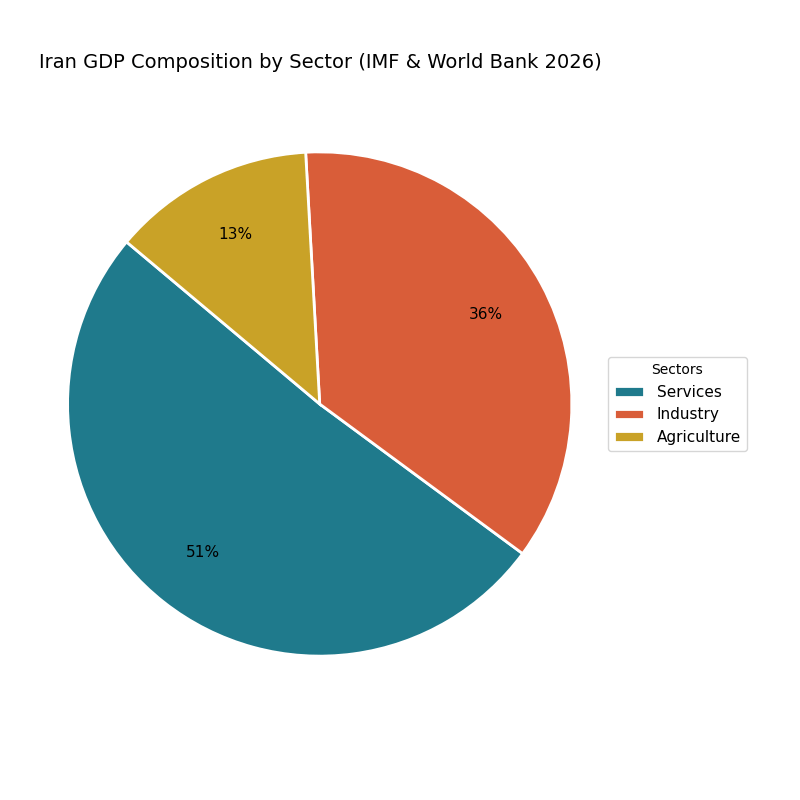
The Iran Economic Outlook IMF 2026 Forecast, and the World Bank reports show that the Iranian economy is mainly driven by the services sector, which accounts for 51% of national GDP. The services sector comprises trade, transport, communications, and financial services.
The second-largest sector of the economy is the industrial sector, which has a 36% share of GDP and includes oil and gas, manufacturing, and construction, among others. The third largest is agriculture, which contributes 13% to GDP, and is composed of forestry, fishing, etc.
Domestic vs External Debt Structure in Iran
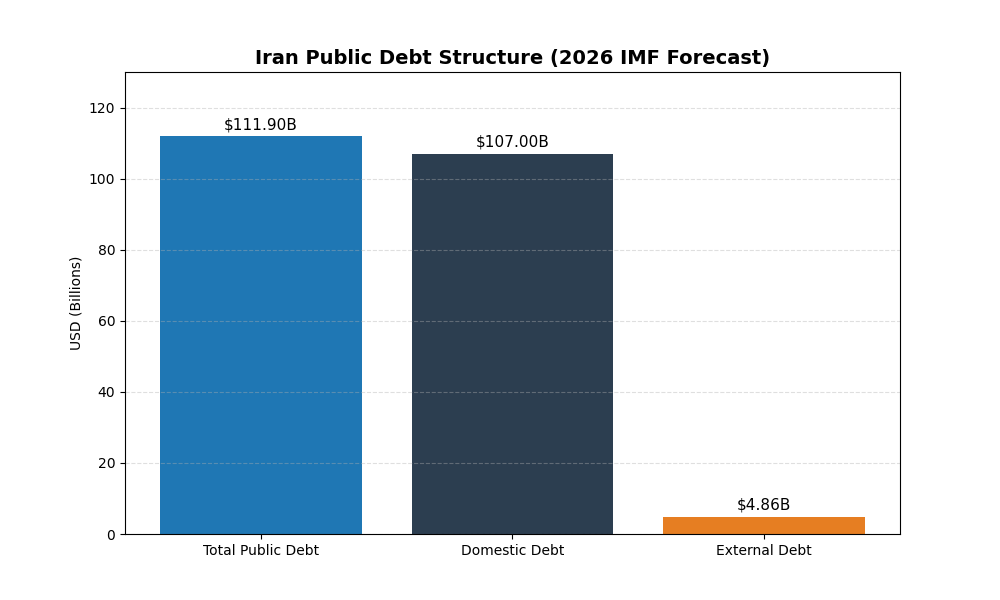
The total public debt of Iran is $111.9 billion, which makes 37.3% of GDP for 2026, based on the nominal GDP of Iran, projected at $300.29 billion, as mentioned by the Iran Economic Outlook IMF 2026 Forecast. Total public debt is also called the general government gross debt. This percentage of GDP is valid if debt remains the same for the year 2026, as the GDP of $300.29 billion is forecast for 2026, not the current one.
The General Government Gross Debt can be decomposed into foreign public debt and domestic public debt. The foreign (external) debt of Iran is only $4.86 billion (1.62% of GDP for 2026), while public domestic debt is estimated at around $107 billion at the exchange rate, as of April 2026, according to the IMF (World Economic Outlook).
Based on Iran’s current GDP of $371 billion, total debt is 30.2% of GDP, with foreign debt at 1.31% and domestic debt at 28.8%.
Foreign debt has mostly been taken from China and Russia. Due to sanctions, the IMF and the World Bank are restricted from giving loans to Iran.
Foreign Direct Investment (FDI) in Iran: IMF 2026 Outlook and Trends
Iran is not a major FDI attracting economy internationally, due to a major factor of Sanctions, and another prominent reason is banking/payment restrictions. Foreign direct investment (net inflows) to Iran isapproximately $1.45 billion according to the latest data available for 2024. As % of GDP, it is about 0.33% of Iran’s GDP (2024). FDI inflow was at its peak in 2017 at $5.02 billion.
Total FDI Inward Stock in Iran is around $62.1 billion by the end of 2024. Countries that have investments in Iran are China, Russia, the UAE, Turkey, and India.
Iran Economic Outlook IMF 2026 Forecast and related World Bank data show that Iran’s FDI outflows are very low due to global sanctions and limited international capital mobility. Net FDI outflows of Iran were at around $328 million, according to the latest data available for 2024–2026.
Total Outward Stock is roughly $4.25 billion by the end of 2024. Iran’s investment partners (FDI outflow) are China, Iraq, the UAE, Turkey, and Russia.
Iran’s Trade Structure and Key Commodities
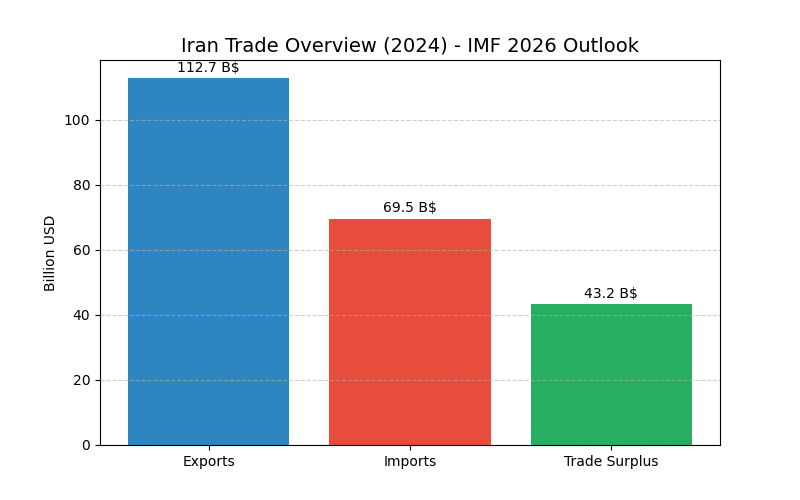
According to the Iran Economic Outlook IMF 2026 Forecast, 1st of April, actual exports of Iran are $112.7 billion for the calendar year 2024, and Imports of Iran are around $69.5 billion for the same period. Iran is facing a trade surplus of $43.2 billion.
Major exports of Iran are crude oil, natural gas, petroleum gas, ethylene polymers, iron ore, pistachios, saffron, raisins, and watermelon, while the chief imports are gold and precious metals, machinery & nuclear reactors, vehicle parts, maize, wheat & meslin, soybeans, and rice, etc.
Iran Budget Scenario in IMF 2026 Outlook
Iran’s current fiscal year starts on March 21, 2026, and ends on March 20, 2027. As of the Iran Economic Outlook IMF 2026 Forecast, the primary deficit is expected to be 3.04% of GDP, while the overall budget deficit of Iran is expected to be 5.2% of GDP.
IMF reports that total expenditures of Iran for the budget 2026-27 are expected to be 16.14 trillion new rials (18.6% of GDP); on the other hand, overall revenues are expectedly 11.62 trillion new rials (13.4% of GDP). So, the budget deficit is expected to be 4.52 trillion new rials (5.2% of GDP).
Contrary to the IMF projections, Iran’s federal budget estimates are somewhat different, which were officially submitted by President Masoud Pezeshkian to the Iranian parliament in December 2025. According to this:-
Total budget outlay/ expected expenditures are around 14.44 trillion new rials, including (general government spending of 5.95 trillion new rials + state-owned entities of 8.90 trillion = around 14.44 trillion new rials). The expected total revenue target is 12.54 trillion new rials (tax revenue target of 3.30 trillion, Oil & Gas revenue target of 2.00 trillion, and expected amount of 7.24 trillion by selling Other/Assets). Budget deficit projections are at 1.90 trillion new rials (only 2.2% of GDP).
IMF says Iran’s expenditures will rise due to defense and social safety needs, as a result of regional conflict & high rate of inflation.
Poverty Scenario in Iran
In Iran, the poverty level is high due to high inflation, continuous sanctions for the last 47 years, and a few other factors contributing to prevailing poverty. Iran Economic Outlook IMF 2026 Forecast for April, the 38.8% of the population is estimated to live below the poverty line. This denotes a sharp surge from 33.2% in 2024 to 35.4% in 2025.
With the upper middle-income country poverty criterion of $8.30/day, approximately one-third of Iranians are poor. Around 34 to 35 million Iranians are poor, with a population of 92 million in 2026.
The World Bank projects that due to economic contractions and high prices, an additional three million people will fall into poverty in 2026.
Foreign Exchange Reserves of Iran
Total forex of Iran is $134 Billion to $154 Billion. Among these, $33.8 Billion in the custody of the central bank (usable, less than $10 billion + unusable $23.8 billion), while the frozen forex of Iran from overseas remains at roughly $100 billion to $120 billion blocked globally. These reserves are notably in China ($20B), India ($7B), Iraq ($6B), Japan, the USA, the European Union, and other places in the world. These figures are according to the Iran Economic Outlook IMF 2026 Forecast.
Conclusion
After doing an analysis of the Iran Economic Outlook IMF 2026 Forecast, I have concluded that the State of Iran has much economic and social resilience. Despite the global sanctions for the last more than four decades, its economy is performing well and stands as an upper-middle-income economy in the world.
Although its real GDP growth rate performed negatively, and the International Monetary Fund’s projection for the year 2026 is at -6.1%, despite this, Iran’s exports are more than imports, public debt is low (only 37.3% of GDP), per capita income is reasonable, the poverty situation is not worse, and unemployment is controllable.
The key concluding point is that if there were no ongoing sanctions, Iran would have a major economic power in the Gulf region, as well as in the world.
Q- What is the inflation rate in Iran in 2026
The inflation rate in Iran is expected to be 68.9% in 2026, according to the IMF
Q- What is the nominal GDP of Iran in 2025
Nominal GDP of Iran is 371 billion dollars in 2025
Q- What is the projected economic growth rate in Iran in 2026, according to IMF
The projected economic growth rate in Iran in 2026 is -6.1% according to the IMF
Q- What are the exports of Iran in 2026
The exports of Iran in 2026 are $112.7 billion
Q- What is the foreign debt of Iran in 2026
The foreign debt of Iran is 4.86 billion dollars in 2026, according to the IMF
Q- What is the total public debt of Iran in 2026
The total public debt of Iran is 111 billion dollars in 2026