
US Economy 2025–2026 IMF Forecast: Growth, Inflation, and Future Outlook
Introduction
The US economy 2025–2026 IMF forecast replicates a period of gradual modification for the world’s biggest economy. According to the International Monetary Fund, the United States in 2025 displays resilience reinforced by robust employment and stable demand, in spite of inflation and tight financial situations. Looking ahead to 2026, growth is projected to increase reasonably as policy tightening and global reservations form the economic position.
This article makes available a data-driven analysis of important macroeconomic indicators, such as economic growth rate, nominal GDP, GDP at PPP, inflation, unemployment, per capita income, debt, FDI, foreign exchange reserves, poverty situation, international trade, and federal budget position, based on IMF estimates.
1. US GDP Growth Rate (2025–2026 IMF Forecast)
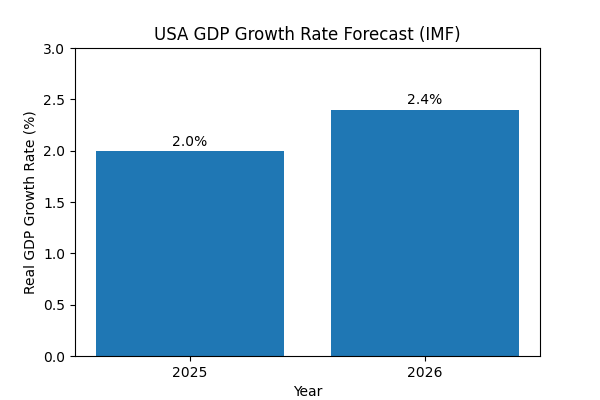
The IMF projects that the real economic growth rate in the US for 2025 is almost 2.0%, showing a moderate increase driven by consumer spending and investment. This growth slowed to some extent compared to earlier years.
US economy 2025–2026 IMF forecast illustrates that for 2026, the International Monetary Fund estimates growth at around 2.4%, but the War in the Gulf may affect the real GDP growth in the economy.
My analysis depicts that the United States economy is typically one of the advanced economies in the world. Its economic growth is not so high, but stable. The economy is stable and strong due to Govt spending, technological innovation, domestic demand, and AI.
2. US Nominal GDP (2025–2026 IMF Forecast)
Nominal GDP of the USA is estimated at $30.6 trillion, continuing the U.S. position as the biggest global economy, according to the IMF. The 2026 forecast for nominal GDP is anticipated at $31.8 trillion, driven by both real growth and price rises. The U.S national income accounts for approximately 25% of global nominal GDP, indicating its dominance in global economic output. As the world’s nominal GDP is 117 trillion dollars in 2025, the forecast for 2026 is 123 trillion dollars (IMF).
The US economy 2025–2026 IMF forecast represents the GDP of the US at Purchasing Power Parity (PPP), which stands at 30.6 trillion dollars, the same as nominal GDP. The US economy 2025–2026 IMF forecast for 2026, PPP GDP is at 31.8 trillion dollars, the same as nominal national income; the IMF endorses these figures. Purchasing power GDP shows the purchasing power of the people, adjusted for price differences.
3. US Inflation Outlook for 2025 and 2026
The US inflation forecast 2025 2026 estimates the inflation rate in the US for 2025 at 2.7%, while the 2026 forecast for inflation in the USA is at 2.4%. The IMF examines that inflation is moderating but persistent in 2025. In April 2026, the inflation rate increases due to the oil price hike in the Iran-US War. If the Gulf War continues, then inflation in the US can increase further.
4. US Unemployment Rate (2025–2026 IMF Forecast)

Unemployment rate in the US is projected at around 4.1% in 2025, showing a tight but, to some extent, cooling labor market. Unemployment in the USA is expected to decline to 4.0% in the 2026 forecast, according to the International Monetary Fund. The American labour market remains close to full employment and highly flexible. It shows a strong job market.
The US economy 2025–2026 IMF forecast tells that the IMF puts the USA’s labor force at 170 million people in 2025, approximately out of the USA population of 340 million. It means fifty percent of people are included in the working force, out of which 6.8 million people are unemployed, and 163.2 million people are employed. The annual population growth rate in the USA is 0.5% in 2025.
Other than the labor force population of 170 million, which included 70-75 million children, 15–20 million College and university students, 20–25 million Homemakers (often women), 55–60 million People above retirement age or above (65+) who are not at work, 20–25 million People not seeking jobs or inactive workers, etc.
5. United States Per Capita Income Growth (IMF Estimates)
The U.S. population is about 347 million in 2025. Nominal GDP of the USA is 30.4 trillion dollars. By dividing GDP by population, we get a nominal GDP per capita of $87,600, which is the highest globally.
In the US economy 2025–2026 IMF forecast, per capita income is expected to increase further due to productivity gains and economic expansion. Such a high level of per capita income shows that the workforce is skilled and the country has advanced technology
6.United States Public Debt Outlook (IMF Estimates)
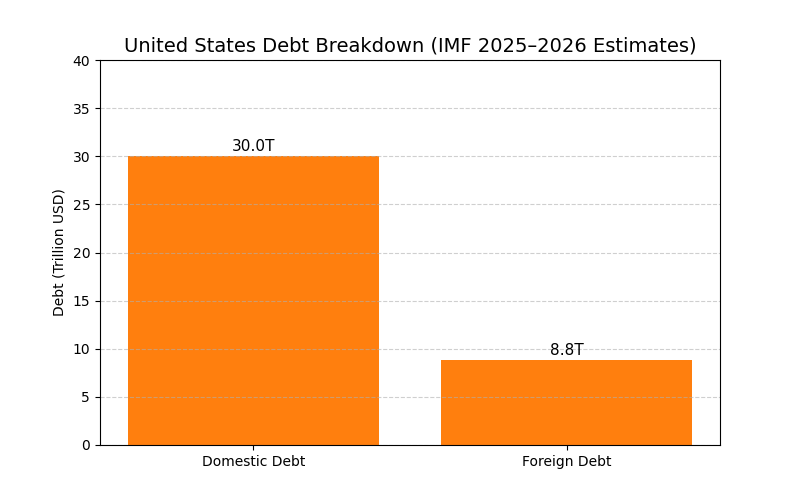
In the context of the US economy 2025–2026 IMF forecast, the United States has huge domestic and foreign debt, which is due to continuous fiscal deficits and high borrowing requirements. According to the IMF 2025–2026 approximations, the total debt of the USA is nearly $38–39 trillion, which is roughly 123–125% of its GDP.
After breaking up the above-mentioned total debt into domestic debt and foreign debt, the domestic debt of the US is estimated at $29–31 trillion, while the foreign debt of the US is estimated at more than $8.5–9.0 trillion dollars. This is from the United States economy, IMF data. The US economic outlook 2026 projects that this debt will increase further, due to Defense expenditure, Social security spending, and Healthcare costs, etc.
7. US Trade Sector (2025 Actual)
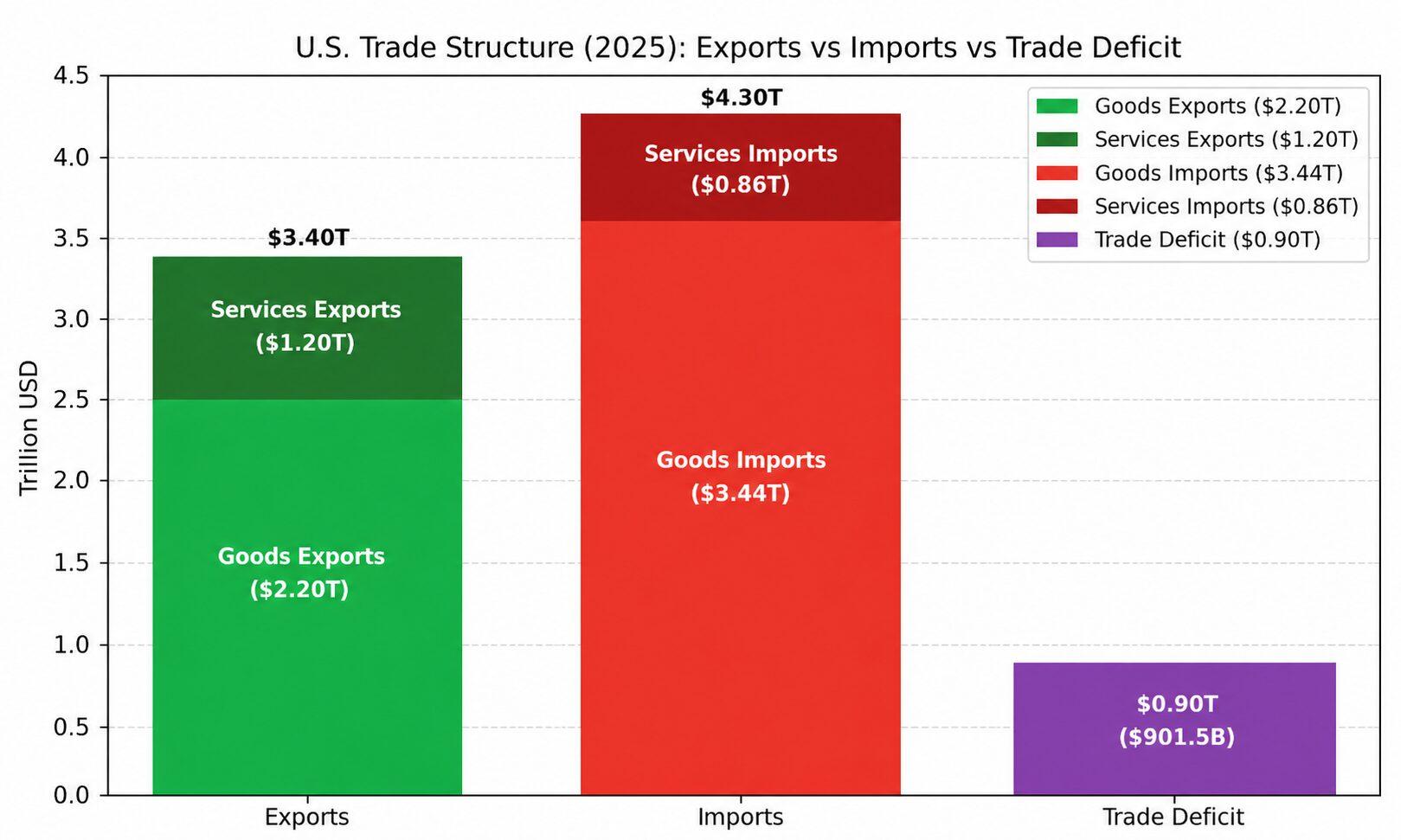
The U.S. is the world’s largest trading nation. According to the latest report, the International Monetary Fund’s World Economic Outlook (April 2026), the (Actual/ finalized 2025) United States exports (Goods & Services) are $3.4 trillion, while imports (Goods & Services) are $4.3 trillion. The U.S. is facing a trade deficit of around $901.5 billion, which means imports exceed exports.
Its breakdown is as follows: Exports of Goods are $2.20 trillion, and of Services are $1.20 trillion; Imports of Goods are $3.44 trillion, and of Services are $860 billion.
8. US International Reserves: Growth and Analysis
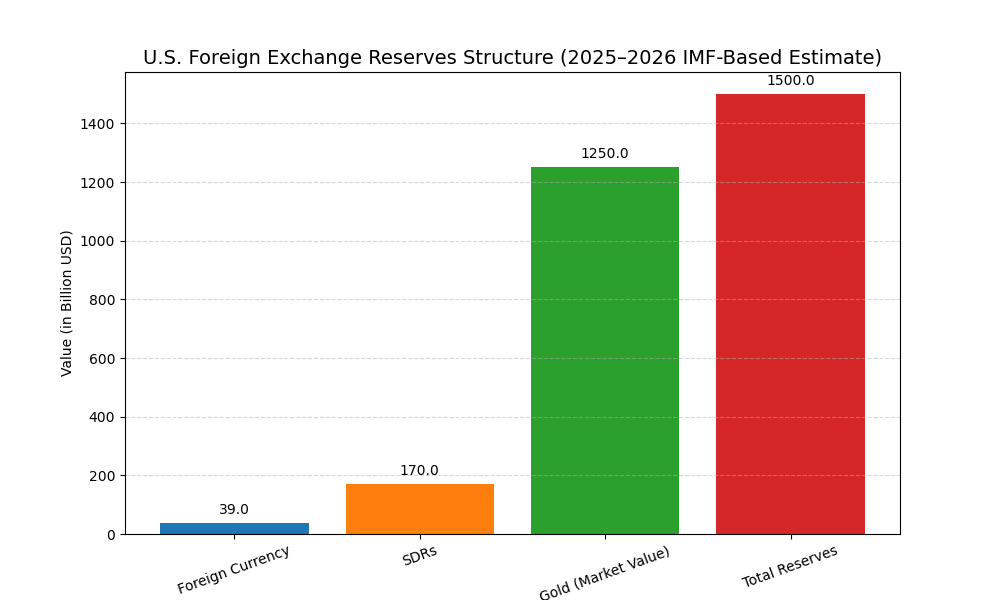
The U.S. forex reserves are designed to support economic stability. The US economy 2025–2026 IMF forecast demonstrates that of its $253.8 billion in official assets, the U.S. keeps $39.0 billion in actual foreign currency, mainly composed of Euros and Japanese Yen, to ease market interventions (according to OECD Data). A huge share, around $170 billion, is held in Special Drawing Rights (SDRs), the IMF’s currency unit.
Nevertheless, the most important hidden strength is the country’s gold. Whereas officially reserved at a 1973 statutory price of just $42.22 per ounce, the 8,133 metric tons of the United States’ gold are valued at over $1.25 trillion at today’s (April 16, 2026) market prices. By accumulating the above-mentioned categories, we get the U.S. with an entire financial backstop of more than $1.5 trillion.
The U.S. reserve situation is exceptional because the U.S. Dollar plays the role of primary global reserve currency; in this sense, the U.S. does not need to uphold huge amounts of currencies of other countries for exchange rate stability.
9. US Foreign Direct Investment (FDI) 2025–2026 IMF Forecast
The US economy 2025–2026 IMF forecast explains that FDI Inflows to the United States are estimated at $350–400 billion, the amount of new foreign investment coming into the U.S. during a calendar year of 2025, while FDI Outflows (U.S. investment to other countries) are expected at $300–350 billion.
FDI Stock (Total value of foreign-owned businesses and assets in the U.S.) remains at $5.5–6 trillion, while FDI Outward Stock (Total value of US-owned businesses and assets in other countries of the world) is at $6.5–7 trillion, up to the end of 2025, expectedly.
Chief investors in the United States are the United Kingdom, Japan, Canada, and Germany, etc., and prominent sectors that receive Foreign Direct Investment are technology, manufacturing, finance, and energy, etc.
The USAis the biggest global hub for overseas investment, fascinating hundreds of billions yearly, while holding trillions in overall Foreign Direct Investment. It is because its economy is stable, has a strong legal system, and a huge consumer market.
10. US Federal Budget Outlook: Revenue and Expenditure Trends
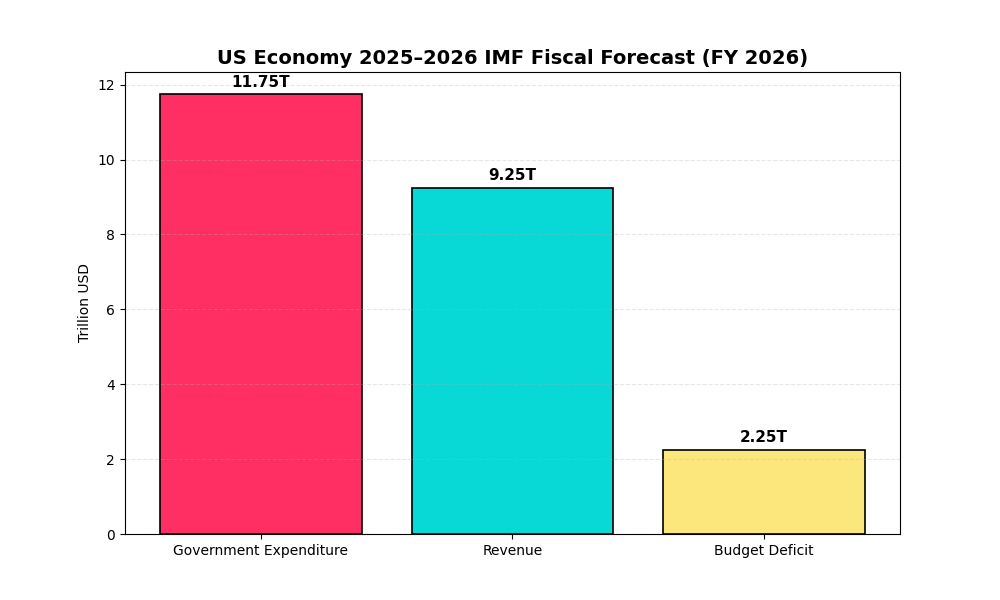
The US economy 2025–2026 IMF forecast specifies that the United States total government expenditure is projected at around $11.75 trillion and revenues of about $9.25 trillion. This budget deficit is approximately $2.25 trillion, almost 7% of GDP. These figures are for the fiscal year 2026, starting from October 1, 2025, and ending on September 30, 2026.
Economists suggest that the fiscal deficit should not be more than 4.5% of GDP. This huge budget deficit of the United States is due to ongoing government expenditure commitments, spending on programs like Social Security, Medicare, high-interest payments on public debt, and high war expenditures, etc.
11. United States Poverty Rate and Wealth Distribution Trends
In the US, poverty is measured in three ways. Firstly, Poverty is officially defined by the United States Census Bureau using the Official Poverty Measure (OPM). If a household’s annual before-tax income is less than the threshold of about $33,000 for a family of four, then it is considered to be living in poverty.
According to this criterion, the poverty rate in the United States has been projected at about 11.5% in recent years. It shows that around 37.9 million people live below the poverty line, when we are discussing the US economy 2025–2026 IMF forecast. This criterion measures absolute poverty.
Secondly, the Supplemental Poverty Measure (SPM) highlights a more precise estimate by including government assistance and essential living costs like housing and health services. Around 43.7 million people in the US are supposed to be poor according to this method, based on 2025–2026 data. The Supplemental Poverty Measure shows a 12.9% poverty rate.
Finally, on the global level, the World Bank’s Prosperity Standard of $28.00 per day (PPP) is used. It advocates that around 35% of the U.S. population (approximately 120 million people) are poor according to this criterion of poverty measurement. The Prosperity Standard includes those who are economically insecure. This measure relative poverty, instead of absolute poverty.
12. Foreign Remittances Position of the United States
The US is a high-income destination economy. A huge number of migrants in the United States send money (remittances) to other countries of the world. According to the World Bank balance of payments data, during the calendar year of 2023, the US observed remittance outflows of around $80–90 billion, while inflows were approximately $20–30 billion.
The US economy 2025–2026 IMF forecast mentions that money sending countries are Mexico, India, China, the Philippines, Nigeria, Central American countries, and Africa.
Conclusion
In conclusion, the US economy 2025–2026 IMF forecast points to a resilient yet gradually slowing economic path. While 2025 replicates strength in the job market and domestic demand, emergent challenges like high interest rates, tight fiscal position, and international economic fears persist as key concerns.
According to the International Monetary Fund, the US economic outlook 2026 advocates more moderate and sustainable growth, motivated by policy modifications and easing inflation. In general, the United States is projected to continue its economic leadership, but with a bigger emphasis on stability and long-term stability.
Q1. What is the GDP growth rate in the US
GDP growth rate in the US for 2025 is almost 2.0%, according to the IMF
Q2. What is the GDP growth rate in the US in 2026
GDP growth rate in the US for 2026 is projected at 2.4%, according to the IMF
Q3. What is nominal GDP in the United States
Nominal GDP in the United States is estimated at $30.4 trillion
Q4. What is GDP at purchasing price parity in the United States
GDP at purchasing price parity in the United States is $30.4 trillion, the same as nominal GDP
Q5. What is the US Foreign Direct Investment (FDI) inflow for 2025 according to IMF Forecast
The US Foreign Direct Investment (FDI) inflow for 2025, according to the IMF Forecast, is $350–400 billion
Q6. What is the trade deficit of the United States
The U.S. is facing a trade deficit of around $800 billion in 2025