
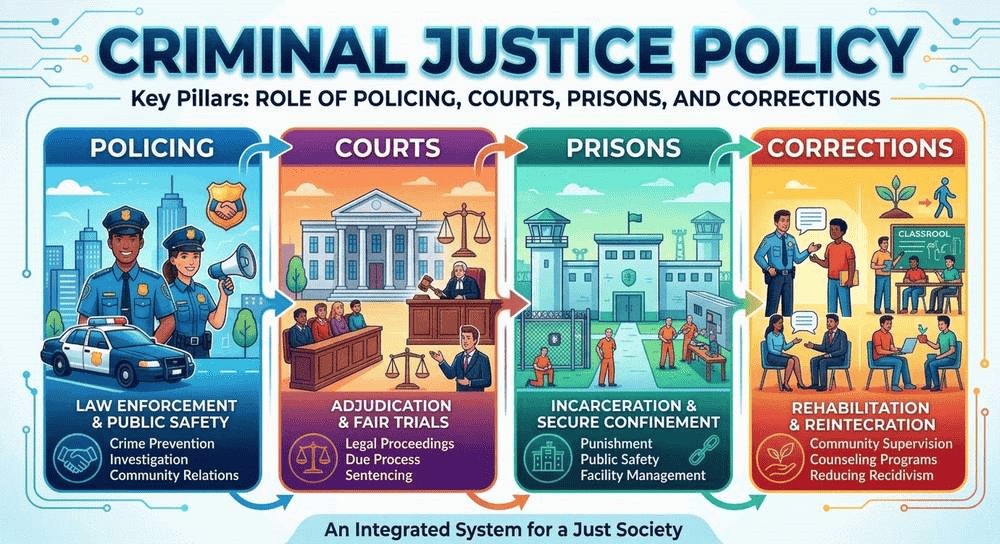
Criminal Justice Policy: The Role of Policing, Courts, Prisons, and Corrections
Introduction
A peaceful society needs more than good laws. It also needs fair institutions and a government that can protect its citizens by preventing crime, investigating offences, providing fair trials, and managing offenders lawfully. This is where Criminal Justice Policy becomes important.
Criminal Justice Policy refers to the laws, regulations, decisions, and strategies that guide how a country responds to crime. It covers the whole process, from crime prevention and policing to court proceedings, imprisonment, and rehabilitation. Its purpose is to protect society while upholding justice, individual rights, and accountability.
Public Policy in Criminal Justice determines how police departments operate, how courts deliver justice, and how prisons manage offenders. This article explains the responsibilities of each institution and how they help maintain law and order, with brief examples from Pakistan, the United States, and Europe.
1. Police and Law Enforcement
Police and law enforcement agencies are usually the first institutions to respond to crime, which makes them central to the Criminal Justice System. They prevent crime, investigate offences, maintain public order, protect citizens, and arrest suspects in accordance with the law.
Government policy sets their legal powers, budgets, recruitment standards, and training requirements. Effective policing depends on professional officers who know the law and respect citizens’ rights.
Key areas of policing policy include:
- Crime prevention: Strategies to reduce crime and improve public safety.
- Professional training: Preparing officers to investigate crimes, collect evidence, and deal with the public professionally.
- Accountability: Complaint procedures and oversight mechanisms that prevent misuse of authority.
- Community policing: Building cooperation between officers and local communities.
- Modern technology: Digital records, forensic facilities, and modern communication systems that strengthen investigations.
Police departments often struggle with corruption, political interference, limited resources, weak investigation procedures, and low public trust.
Example from Pakistan: Police departments in Pakistan face ongoing challenges in resources, professional training, investigation capacity, and accountability. Policies that strengthen professional standards and public oversight can improve police performance and public confidence.
2. Courts and the Administration of Justice
Courts and the judicial system ensure that laws are applied fairly. They examine criminal cases, evaluate evidence, hear both sides, protect legal rights, and decide whether an accused person is guilty.
Governments influence court performance through judicial policies, legal procedures, budgets, appointments, and institutional reforms. Judicial independence is essential, however, because judges must decide cases without improper political or external pressure.
An effective Courts and Judicial System should provide:
- Fair trials: Every accused person should have the opportunity to defend themselves.
- Judicial independence: Courts must decide according to law and evidence.
- Timely justice: Criminal cases should be resolved without unnecessary delay.
- Access to justice: Legal assistance should be available regardless of a person’s financial position.
- Protection of victims and witnesses: Appropriate measures should safeguard people involved in criminal proceedings.
Court delays, complicated procedures, a shortage of judges, and weak investigations can all prevent timely justice. Long delays also increase the number of people held in detention while awaiting trial.
Example from the USA: Plea bargaining is widely used in the American criminal justice process. Prosecutors and defendants negotiate an agreement, often avoiding a full trial. This can reduce court workloads, but safeguards are needed to ensure defendants are not pressured into unfair agreements. The US Sentencing Commission publishes official statistics comparing guilty pleas and trials in federal cases.
3. Prisons and Correctional Policy
Prisons hold individuals in custody after they have been lawfully sentenced. Modern criminal justice policy recognises, however, that imprisonment should not stop at punishment. It should also offer opportunities for rehabilitation and prepare offenders to return to society.
Prison and Correctional Policy covers the laws, regulations, and programmes that guide prison administration and the treatment of prisoners, including security, healthcare, education, vocational training, counselling, and rehabilitation.
The main objectives of effective correctional policy are:
- Safe custody: Maintaining security and protecting prisoners and staff.
- Human rights: Providing basic healthcare, food, sanitation, and protection from abuse.
- Education and training: Helping prisoners develop knowledge and practical skills.
- Rehabilitation: Addressing behavioural problems and preparing offenders for responsible lives after release.
- Reducing reoffending: Supporting prisoners through counselling, employment preparation, probation, and reintegration programmes.
Overcrowding, poor living conditions, inadequate healthcare, violence, and limited rehabilitation opportunities remain major challenges in many countries.
Example from Pakistan: The Annual Prisons Data Report 2026, published by the National Commission for Human Rights and Justice Project Pakistan, recorded 110,513 prisoners against an authorised capacity of 68,832. It also reported that approximately 75% of prisoners were awaiting trial. These figures highlight the need for timely court proceedings, effective bail procedures, and alternatives to unnecessary detention.
Example from Europe: European countries use probation and other community-based measures alongside imprisonment. Eligible offenders can remain in the community under supervision instead of serving every sentence in prison. The Council of Europe’s SPACE project collects comparative information on imprisonment and non-custodial sanctions across its member states.
4. Importance of Effective Criminal Justice Policy
Effective Criminal Justice Policy matters for four main reasons:
- It protects citizens and maintains public order. When police investigate professionally and courts ensure accountability, people feel safer in their communities.
- It strengthens public confidence in government institutions. Citizens are more likely to respect the law when they believe the same standards apply fairly to everyone.
- It protects fundamental rights. Fair arrest procedures, independent courts, and humane prison conditions help prevent injustice and the misuse of authority.
- It can reduce reoffending. Education, vocational training, counselling, and reintegration support give offenders a better chance of returning to society as responsible citizens.
5. Major Challenges and Policy Solutions
The challenges facing the criminal justice system are closely connected. Weak policing leads to poor investigations, court delays lengthen pretrial detention, overcrowded prisons make rehabilitation difficult, and corruption undermines public trust.
Governments can address these problems through practical reforms:
- Improve police training: Strengthen investigation skills, professional conduct, and knowledge of human rights.
- Strengthen judicial institutions: Improve court management, provide adequate resources, and reduce unnecessary delays.
- Expand legal assistance: Make legal aid available to people who cannot afford private lawyers.
- Reduce unnecessary detention: Improve bail procedures and use lawful alternatives to imprisonment where appropriate.
- Improve prison conditions: Provide better healthcare, sanitation, education, and vocational training.
- Strengthen accountability: Establish transparent complaint systems and effective oversight of criminal justice institutions.
- Promote rehabilitation: Expand probation, parole, counselling, and reintegration programmes for eligible offenders.
These reforms require proper funding, political commitment, reliable data, and cooperation among police, courts, prison authorities, and communities.
Conclusion
Criminal Justice Policy is an essential part of public administration because it determines how governments prevent crime, enforce laws, administer justice, and manage offenders. Police and law enforcement agencies protect citizens and investigate offences, courts ensure fair trials, and prisons and correctional institutions carry out sentences and support rehabilitation.
Pakistan, the United States, and European countries use different approaches but share common goals: public safety, fairness, accountability, and the prevention of future crime. Governments can build stronger institutions by improving policing, ensuring timely justice, protecting human rights, and investing in rehabilitation.
Ultimately, an effective criminal justice system does more than punish offenders. It protects the innocent, strengthens the rule of law, and creates a safer and more just society.
Frequently Asked Questions (FAQs)
1. What is Criminal Justice Policy?
Criminal Justice Policy refers to the laws, decisions, and strategies that guide crime prevention, policing, court proceedings, punishment, and rehabilitation.
2. What is the role of police in the criminal justice system?
Police prevent crime, investigate offences, maintain public order, protect citizens, and arrest suspects according to the law.
3. Why are courts important in criminal justice?
Courts ensure fair trials, examine evidence, protect legal rights, determine guilt, and impose sentences according to the law.
4. What is Prison and Correctional Policy?
It covers prison administration, prisoner rights, security, rehabilitation, education, vocational training, and reintegration into society.
5. How can governments improve the criminal justice system?
Through professional police training, independent courts, timely trials, access to legal aid, better prison conditions, and effective rehabilitation programmes.
6. Why is rehabilitation important?
Rehabilitation helps offenders develop useful skills, address behavioural problems, and prepare for life after release. It can also reduce the risk of reoffending.
References and Further Reading
- Justice Project Pakistan (2026). Pakistan Prison Data Report 2026.
- Council of Europe. SPACE – Council of Europe Annual Penal Statistics.
- United States Sentencing Commission (2025). 2024 Federal Sentencing Statistics.
- United Nations Office on Drugs and Crime (UNODC). Data and Analysis.
- United Nations. Sustainable Development Goal 16: Peace, Justice and Strong Institutions.