
7 Assumptions of the Law of Demand with Simple Examples
Introduction
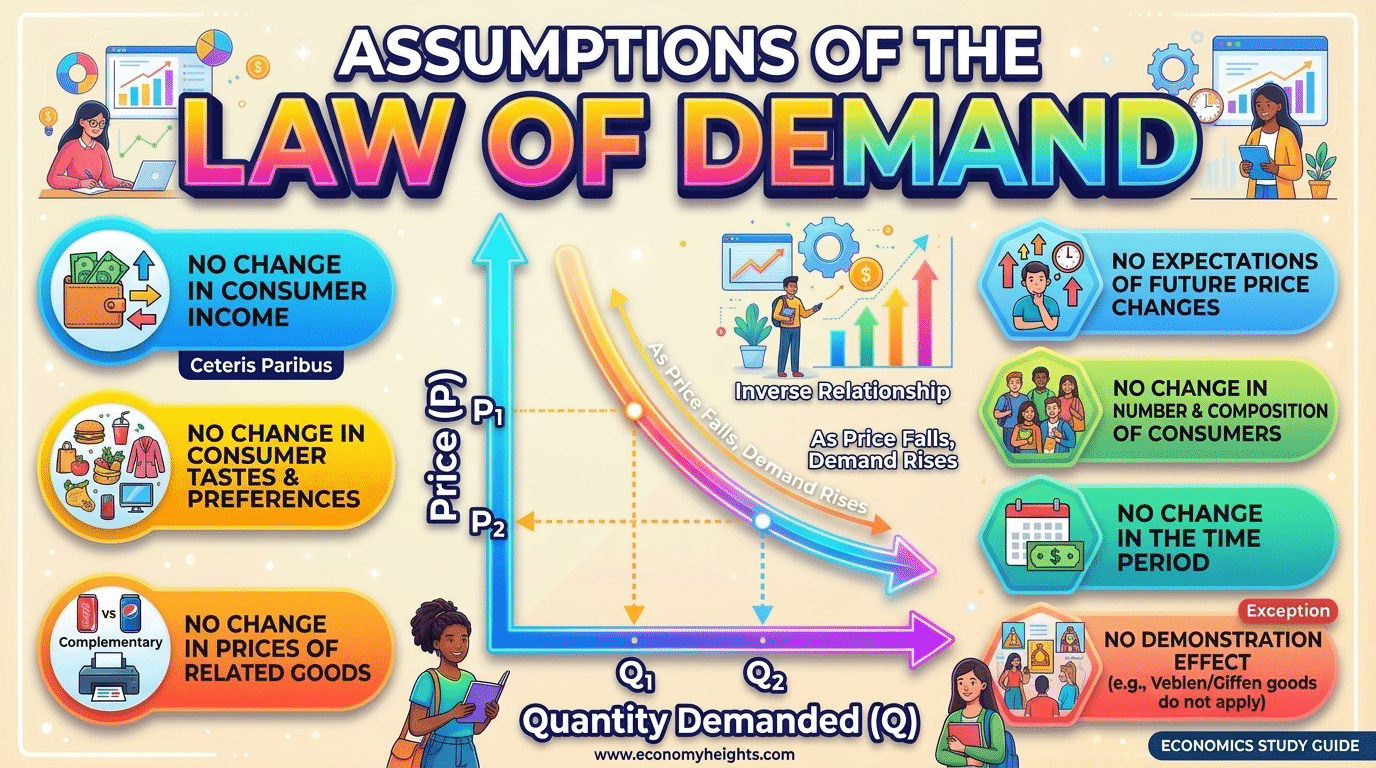
The law of demand is one of the fundamental principles of economics. It explains the relationship between the price of a product and the quantity consumers are willing and able to purchase. According to this law, when the price of a product decreases, its quantity demanded generally increases. Conversely, when the price increases, its quantity demanded usually decreases, other things remaining equal.
However, this relationship does not operate independently of other economic factors. Economists assume that certain conditions remain unchanged while examining the effect of price on quantity demanded. Understanding the assumptions of the law of demand with simple
examples helps students see how this economic principle works in everyday markets.
The Latin expression ceteris paribus means “other things being equal.” It is the basic assumption behind the law of demand.
7 Main Assumptions of the Law of Demand
The conditions of the law of demand explain which factors must remain unchanged when studying the relationship between price and quantity demanded.
The following are seven important conditions of the law of demand.
1. No Change in Consumer Income
The first assumption is that consumers’ income should remain constant. Income affects purchasing power and influences how much people can afford to buy.
Example: Suppose a consumer’s income is 1 lakh rupees for a month, and he purchases five kilograms of rice every month at Rs. 300 per kilogram. If his income rises to 2 lakh rupees for a month and the price of rice also increases to Rs. 400 per kilogram, the consumer can purchase more rice, instead of the rising price of rice, because his income has increased. In this situation, the law of demand will be violated.
So, it is a must that consumers’ income must not change if we want to check the true functionality of the law of demand.
2. No Change in Consumer Preferences
Consumer tastes, habits, customs, weather conditions, fashion, and other preferences are assumed to remain unchanged. A change in preferences can influence demand even when the product’s price stays the same.
Example 1: Suppose people regularly purchase tea. If their preferences suddenly shift towards coffee, demand for tea may decrease, even if its price falls.
Example 2: If a thing comes into fashion, consumers will buy more at the same price or even at a higher price; conversely, if a thing becomes out of fashion, people buy less at the same price or even at a lower price. Like women buy more dresses even at higher prices.
Therefore, when studying the assumptions of the law of demand with simple examples, it is important to understand that consumer preferences/ fashion/ tastes/ habits/customs, etc., must remain unchanged.
3. No Change in the Prices of Related Goods
Substitute and complementary goods are called related goods, and here it is assumed that the prices of related goods remain unchanged. Otherwise, our law of demand will be violated.
Substitute goods can replace each other, such as tea and coffee, mutton and beef, rice and wheat, Pepsi and Coca-Cola, or travel by train or by bus.
Complementary goods are consumed together/ that complete each other, such as cars and petrol, Pants and shirts, Pencil and copy, bat and ball, etc.
Example 1: In the case of substitutes, such as tea and coffee. For example, if a person takes two cups of tea and two cups of coffee daily, and the price of a cup of tea and coffee is the same. Now suppose the price of coffee increases; the consumer will skip one cup of coffee and will take three cups of tea daily instead of two, without changing the price of tea, but due to a change in the price of a related good (coffee).
If it happens so, our law will fail, so fix this law; it is imperative that there should be no change in the price of the substitute good or service.
Example 2: In the case of complementary goods such as cars and petrol. If the price of petrol rises, people will buy fewer cars at the same price of cars, even if the car prices come down. So, to prove this law of demand, it is important to assume the prices of complementary goods will remain the same.
4. No Change in the Availability or Discovery of Substitute Goods
The availability of alternative/ substitute products can influence consumer choices and demand.
Example 1: Suppose consumers regularly purchase a particular brand of mobile phone. If several attractive alternative brands enter the market, some consumers may switch to those alternatives, affecting demand for the original brand.
Example 2: Suppose people are using petrol-powered cars, now there happened discovery/invention of electric cars. Now people will buy more electric cars and fewer petrol cars, without changes in the prices of petrol cars or even a reduction in the prices of petrol cars.
If this scenario occurs, then the law of demand will fail, so it is important to suppose that there is no change in the availability or discovery of substitute goods or services.
5. No Expectation of Future Price Changes
Consumers are assumed not to expect significant future changes in the product’s price. Expectations can influence present purchasing decisions.
Example: If consumers expect the price of cooking oil to increase next week, they may purchase larger quantities today, even if its current price has not changed. In the same way, if there is danger of war, drought, flood, etc., people will buy and accumulate stock of these things even at the same prices or higher prices.
Similarly, expectations of future price reductions may encourage consumers to delay purchases, even if current prices are the same or are lower.
So, to test the law of demand, future price expectations must not change. This is another important condition among the assumptions of the law of demand with simple examples.
6. No Change in Population
The size and composition of the population are assumed to remain constant. Population changes can influence total market demand.
Example: Suppose the population of a town increases because new families move there. Demand for essential products such as food, clothing, and housing may increase.
To study the effect of a product’s price on demand, economists assume that the number of consumers or population of people must remain unchanged. This means the population should neither increase nor decrease.
7. Homogeneity of Goods
Homogeneity means that all units of a product should be of the same quality, size, shape, and characteristics. Then, the law of demand will be true.
Example: Suppose you buy 1 kg of good-quality apples for Rs. 300. When the price decreases to Rs. 200, you buy 2 kg of the same-quality apples. Your demand increases because the price has decreased. But if the quality of the apples also decreases, you might not buy more apples, even if the price has come down.
So, homogeneity of goods and services is necessary to prove the law correct while I am explaining the assumptions of the law of demand with simple examples.
Why Are These Assumptions Important?
These assumptions help economists study the relationship between price and quantity demanded without confusing it with other influences.
The law of demand in economics describes a movement along the same demand curve when the product’s own price changes, while other relevant factors remain constant.
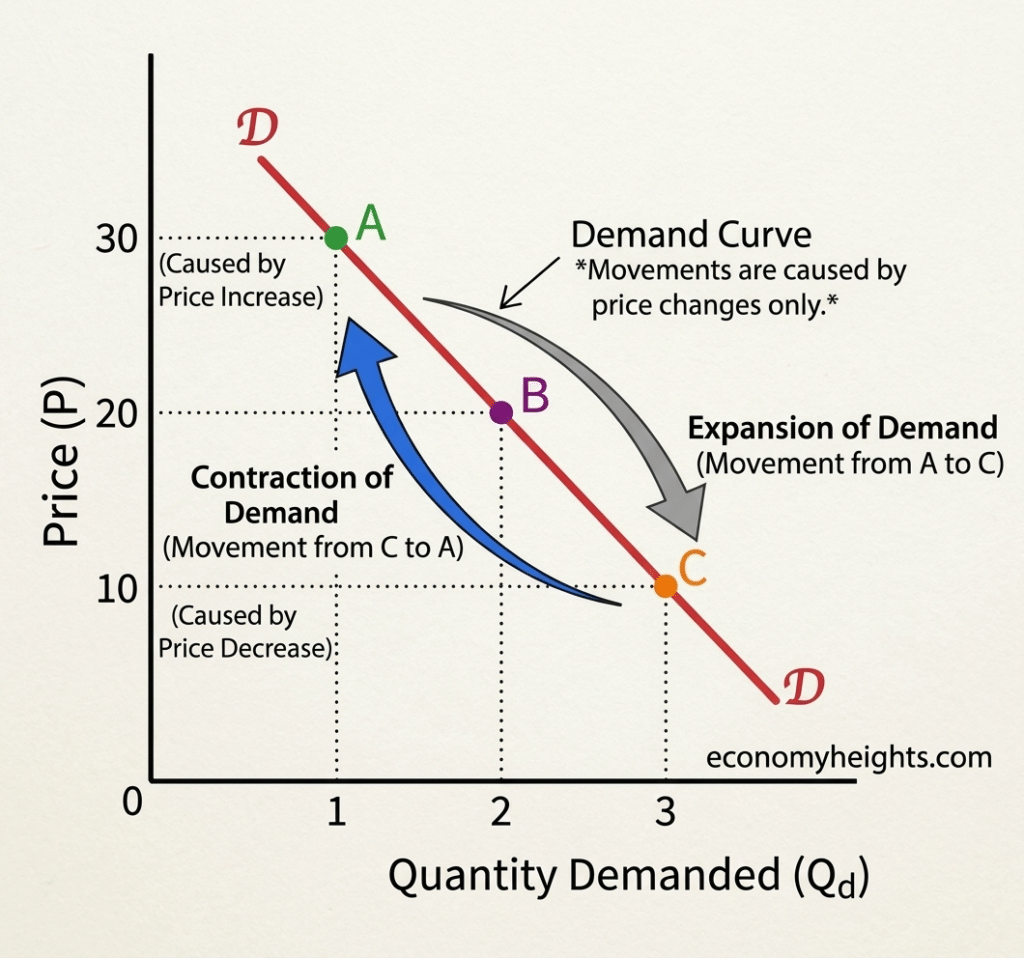
However, when income, preferences, price of related goods, discovery of substitute goods, population, or other determinants change, the entire demand curve may shift.
This distinction is essential for understanding consumer behaviour in economics and analysing the factors affecting demand.
In this way, the assumptions of the law of demand with simple examples, make it easier to understand the practical application of the law in everyday markets.
Conclusion
The seven assumptions of the law of demand provide a foundation for understanding how consumers respond to price changes. They explain why economists use the ceteris paribus condition when studying demand.
In actual markets, income, preferences, price of related goods, and other factors frequently change. Nevertheless, keeping these conditions constant makes it easier to understand the basic relationship between price and quantity demanded. It also helps students develop a clearer understanding of demand analysis.
A clear understanding of the assumptions of the law of demand with simple examples also helps students distinguish between movements along a demand curve and shifts in the demand curve.
Q. What Are the Assumptions of the Law of Demand with simple Examples?
The seven assumptions include constant consumer income, unchanged preferences, stable prices of related goods, no expectations of future price changes, unchanged population, homogeneity of goods & services, and no change in the availability of substitute goods.
Q. 2. What is the meaning of ceteris paribus in economics?
Ceteris paribus is a Latin expression meaning “other things being equal.” In economics, it means that other relevant factors remain constant while examining the effect of a particular variable, such as price, on demand.
Q. Why are assumptions necessary for the law of demand?
Assumptions help economists isolate the relationship between price and quantity demanded. Without them, changes in income, preferences, or other factors could influence consumer purchasing decisions.
Q. What happens when the assumptions of the law of demand change?
When other determinants of demand change, the demand curve may shift to the right or left. For example, an increase in consumer income generally increases demand for normal goods, even if their prices remain unchanged.
Q. What is the basic principle of the law of demand?
The basic principle states that, other things remaining equal, a higher price generally reduces quantity demanded, while a lower price generally increases quantity demanded.