Foreign Exchange Market: Spot and Forward Markets, Premium and Discount
Introduction
The foreign exchange market, also known as the forex market, is a global financial market where different currencies are bought and sold. It facilitates international trade, investment, tourism, and cross-border payments. For example, a Pakistani importer needs US dollars to purchase goods from an American company.
Foreign exchange transactions mainly involve spot and forward markets. Understanding these markets, along with forward premium and discount, helps businesses manage exchange rate risks and conduct international financial transactions.
What Is the Foreign Exchange Market?
The foreign exchange market is a global marketplace where currencies are exchanged at agreed exchange rates. Banks, financial institutions, businesses, governments, and individuals participate in this market.
Its major functions include:
- Facilitating international trade and payments.
- Supporting foreign investment.
- Providing opportunities to manage exchange rate risks.
- Enabling currency conversion between countries.
According to the Bank for International Settlements (BIS), global foreign exchange trading reached approximately $9.6 trillion per day in April 2025, demonstrating the market’s importance in the global financial system.
What Is the Spot Market?
The spot market is a segment of the foreign exchange market where currencies are exchanged at the current agreed exchange rate. Settlement normally takes place within two business days.
Example: Suppose the current exchange rate is:
1 USD = 280 PKR
A Pakistani importer purchases $1,000 through the spot market
1,000 × 280 = 280,000 PKR
The importer pays Rs. 280,000 to receive $1,000, excluding transaction charges.
The spot market is mainly used for immediate or near-term international payments.
What Is the Forward Market?
The forward market allows two parties to agree today on an exchange rate for exchanging currencies at a specified future date.
Example: A Pakistani importer needs $10,000 after three months. The current spot rate is Rs. 280 per dollar. To avoid uncertainty, the importer enters into a forward contract at Rs. 285 per dollar.
After three months, the importer pays:
Even if the dollar rises to Rs. 295, the agreed forward rate remains Rs. 285 under the contract.
Forward contracts therefore help businesses manage future exchange rate risks.
Difference Between Spot and Forward Markets
| Spot Market | Forward Market |
|---|---|
| Exchange at the current agreed rate. | Rate agreed for a future transaction. |
| Normally settled within two business days. | Settled on an agreed future date. |
| Used for immediate currency needs. | Used to manage future currency risks. |
| Rate is called the spot rate. | Rate is called the forward rate. |
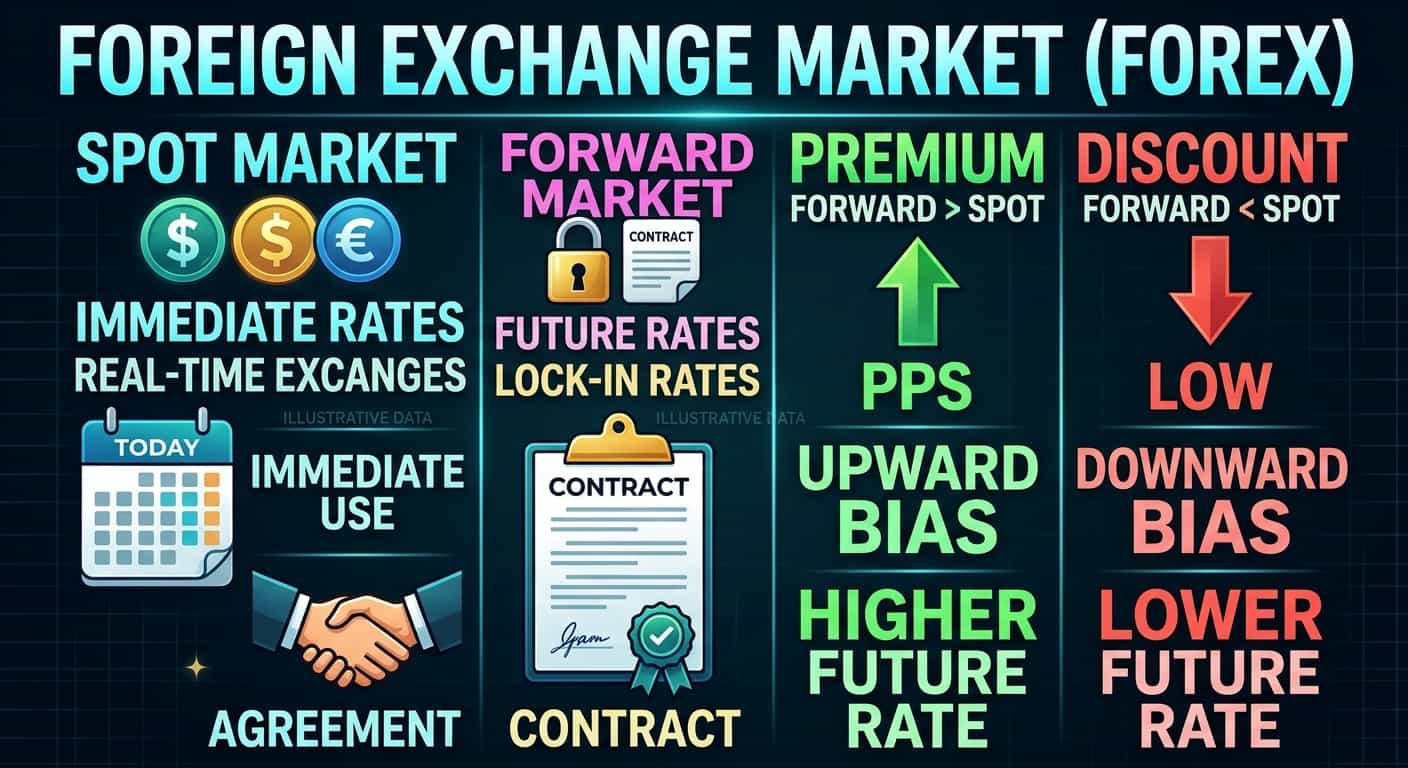
Spot and Forward Market: Illustration
The following diagram shows how the two markets differ in terms of agreement and settlement.

What Are Forward Premium and Forward Discount?
Forward premium and forward discount describe the difference between the spot and forward exchange rates. The interpretation depends on the currency quotation.
Forward Premium
A currency is trading at a forward premium when its forward rate is higher than its spot rate.
For example:
- Spot rate = Rs. 280 per USD
- Three-month forward rate = Rs. 284.20 per USD
The dollar is trading at a forward premium against the Pakistani rupee.
Formula:
Where F = forward rate, S = spot rate, and n = contract period in months.
Thus, the annualized forward premium is 6%.
Forward Discount
A currency is trading at a forward discount when its forward rate is lower than its spot rate.
For example:
- Spot rate = Rs. 280 per USD
- Three-month forward rate = Rs. 277.90 per USD
The dollar is trading at a forward discount against the Pakistani rupee.
Formula:
Thus, the annualized forward discount is 3%.
Forward Premium and Discount: Graphical Illustration
Diagram 2: Comparison of Spot and Forward Rates. Illustrative exchange rates in Pakistani rupees per US dollar. A higher forward rate indicates a premium; a lower forward rate indicates a discount.
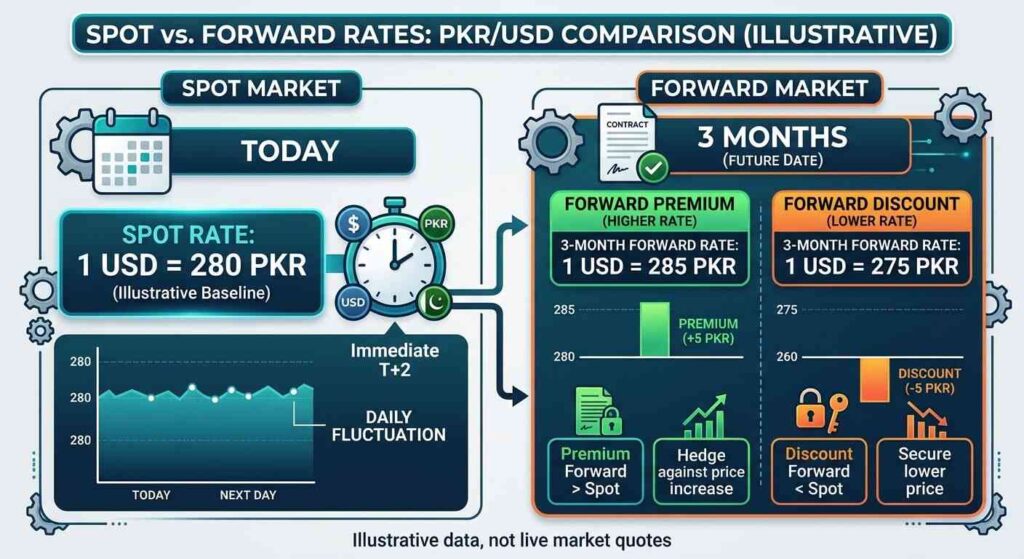
Important: A forward premium or discount does not necessarily predict future currency appreciation or depreciation. Forward rates are strongly influenced by interest rate differences between countries.
Conclusion
The foreign exchange market plays an essential role in international trade, investment, and financial transactions. The spot market facilitates near-term currency exchanges, while the forward market allows businesses to arrange future transactions at predetermined exchange rates. Forward premium and discount explain the relationship between spot and forward rates. Understanding these concepts helps students and businesses better understand international financial markets and manage currency risks.
Frequently Asked Questions (FAQs)
1. What is the main difference between spot and forward markets?
The spot market involves near-term currency settlement, while the forward market involves exchanging currencies on an agreed future date.
2. What is forward premium?
Forward premium occurs when a currency’s forward rate is higher than its spot rate using the same quotation.
3. What is forward discount?
Forward discount occurs when a currency’s forward rate is lower than its spot rate using the same quotation.
4. Why do businesses use forward contracts?
Businesses use forward contracts to reduce uncertainty about future international payments and receipts.