Economic Indicators of China in 2025 and Outlook for 2026
Introduction
China is one of the most prevailing economies in the world, playing a pivotal role in designing global trade, industrial manufacturing, infrastructure, and investment. It is the second-largest country by nominal GDP and the first-largest economy based on purchasing power parity. This elevated macroeconomic situation of China’s economy is thoroughly observed by economists, policymakers, and investors from all over the world. Understanding economic indicators of China supports assessing its economic strong points, structural transformation, and future scenarios.
This article investigates significant economic indicators of China in 2025 and China’s economic outlook for 2026. Major indicators such as GDP growth, per capita income, inflation, employment, poverty, China’s trade balance, and foreign and domestic debt have been elaborated in this article.
GDP Trends and the Trajectory of Economic Growth
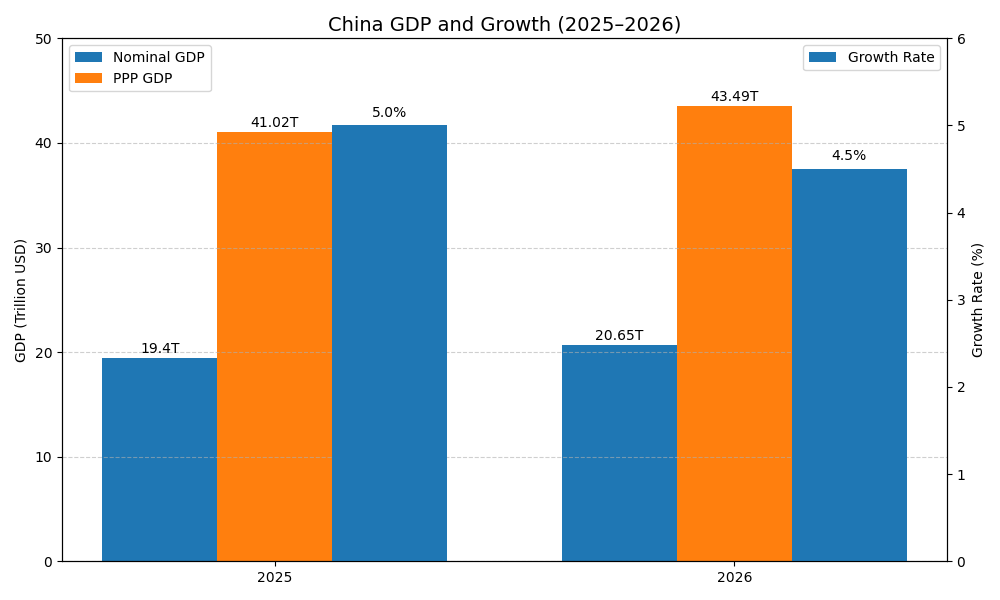
The most significant measure of economic performance is Gross Domestic Product. According to international estimates (IMF), China’s nominal GDP in 2025 touched almost 19.40 trillion dollars (USD), continuing its position as the world’s second-largest economy. In terms of purchasing power parity (PPP), the GDP of China was valued at around 41.02 trillion dollars (International dollars) in 2025, making it the biggest economy in the world by PPP.
As of the IMF, China’s nominal GDP is projected to be almost 20.65 trillion dollars (USD) in 2026, while China’s GDP at Purchasing Power Parity (PPP) is projected to be around 43.49 trillion dollars (international dollars) in 2026, making it the biggest economy at the global level by PPP.
According to the IMF’s 2025 Article IV Consultation, China’s real and nominal GDP rose by around 5.0 % in 2025. The IMF’s predictions for 2026 designate a growth rate of about 4.5 percent, but due to the Gulf/Middle East war, this projection of the IMF for China can vary.
Note:- Nominal and real GDP growth rate is same due to 0 % inflation
GDP Per Capita and Living Standards in China
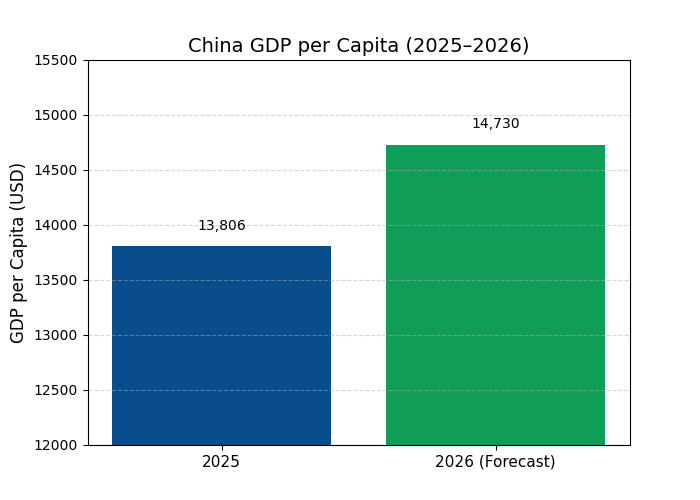
Another significant economic indicator of China is GDP per capita, which calculates the average income level of people. In 2025, China’s GDP per capita reached approximately 13,806 dollars, displaying a steady improvement in living standards. Predictions show that China’s GDP per capita in 2026 could increase to about 14,730 dollars (Statistical Times).
Although China’s GDP is too high, due to a high population, its per capita income is low compared to upper-middle-income economies and advanced countries.
Inflation Dynamics and Stability
Inflation trends are a key indicator of macroeconomic stability. In recent years, inflation in China has remained low. In 2025, headline inflation was near zero percent ( 0%). Projections for 2026, economists think China’s inflation rate will slowly increase but remain modest, according to the IMF. In my opinion, China’s inflation rate can fluctuate due to the Gulf/ Middle East War, as China is a big economy and connected to the world due to trade.
Workforce Dynamics and Employment Trends
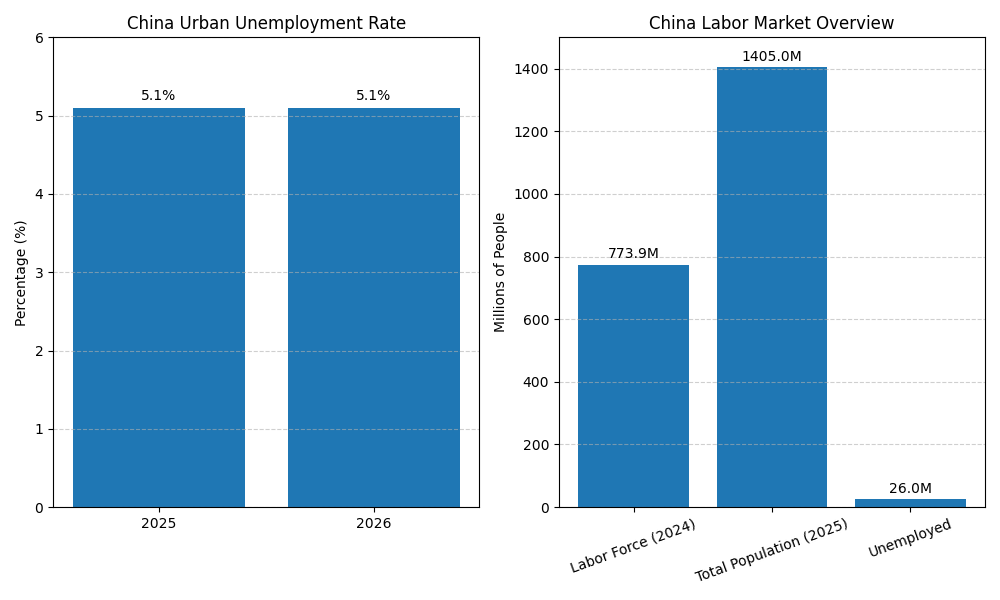
Employment trends highlight one more vital economic indicator of China. The IMF’s Article IV Consultation report displays China’s urban unemployment rate at around 5.1 % (annual average) in 2025, while the urban unemployment rate projection for 2026 is also round 5.1 %.
In 2024, China’s entire labor force, explained as people aged 15 and over who have jobs or are energetically seeking a job, was around 773.9 million people. China’s entire population in 2025 was around 1.405 billion people, according to official data. So, nearly 55 % of China’s whole population was part of the labor force around 2024–25. In China, 26 million people are unemployed, currently (estimated urban unemployed).
External Trade and Balance Overview
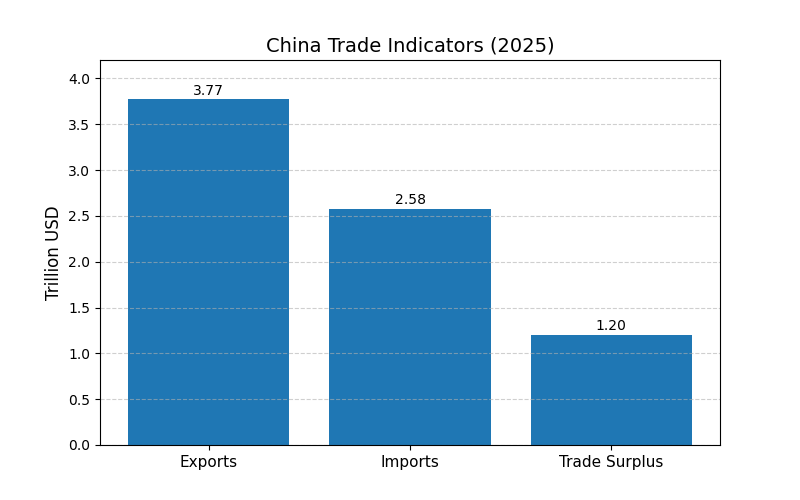
Talking about the economic indicators of China, according to the IMF/Reuters reports for 2025, the total exports of China are $3.77 trillion (goods exports in 2025), while total imports of China are $2.58 trillion (goods imports in 2025). China’s trade balance in 2025 shows a positive sign. China is facing a trade surplus of $1.2 trillion, approximately. Exports increased around 5.5% in 2025 compared with 2024; on the other hand, imports were almost flat.
Foreign Investment in the Economy
Another important area that should be examined when discussing the economic indicators of China is the foreign investment sector. China brought 747.7 billion yuan in foreign direct investment in 2025, around $107.4 billion US dollars, according to China’s Ministry of Commerce facts. This showed a 9.5 % deterioration compared with 2024.
According to China Briefing data (based on Ministry of Commerce/SAFE statistics), China’s total FDI outflows in 2025 touched around RMB 1,245.58 billion, about $174.4 billion US dollars. The investment scenario can change due to the Iran versus Israel-USA War in the Middle East.
Debt Structure: Domestic and Foreign
The total government debt of China is $18.7 trillion (88.3 % of GDP). If I break down into foreign debt and domestic debt, then foreign debt (external loan) is $0.42 trillion or $421.4 billion, and domestic debt (internal loan) is $18.3 trillion (86.4 % of GDP), as of 2025 (IMF + SAFE).
Elaborating on the economic indicators of China, the above-mentioned data shows that China’s loans are mostly internal, with less reliance on external lenders or global financial institutions such as the IMF and World Bank.
On the other hand, China’s whole foreign debt (including private companies and banks) is around $2.33 trillion, and the government is merely responsible for approximately $421.4 billion (17–18%).
Poverty Dynamics in China
China has made remarkable progress in poverty alleviation over the last four decades. According to official government statistics, China has eliminated extreme poverty and lifted over 800 million people out of extreme poverty since 1980.
The national poverty line is currently set at RMB 4,000 per year per capita in rural areas (around $600 USD), adjusted for inflation. (source: World Bank).
According to the very low income standard of $1.6 USD per day, China’s population living below that is close to zero. China’s government officially eliminated extreme poverty nationwide by the end of 2020, but according to the World Bank’s upper-middle-income poverty threshold of $6.85 per day, around 17% of China’s population (around 240 million people) remains poor.
China’s Foreign Reserves
My analysis related to the economic indicators of China for 2026 also focuses on China’s foreign reserves. According to the IMF and official Chinese statistics, China’s foreign exchange reserves were around $3.4 trillion in early 2026. China’s foreign exchange reserves include foreign currencies, such as US dollars, euros, yen, pounds, etc., foreign government bonds, especially U.S.Treasury securities, Gold reserves, and Special Drawing Rights (SDRs) from the IMF. China holds the biggest foreign exchange reserves in the world.
Public Finance: Budget Overview
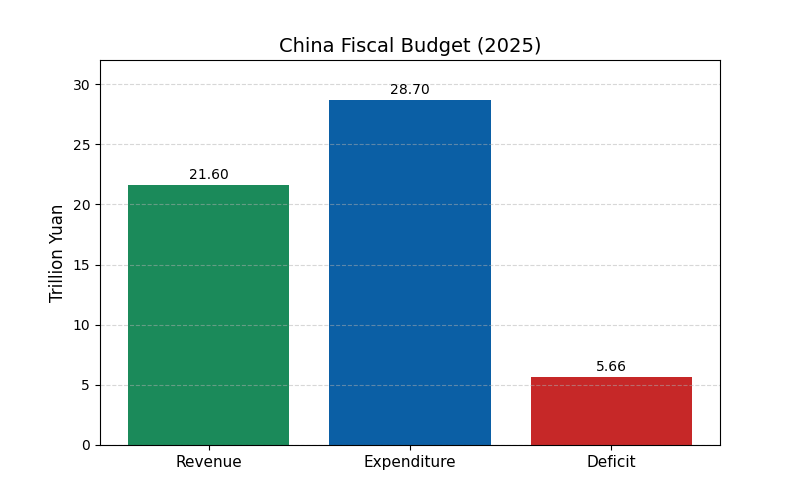
The fiscal year of China starts on 1 January and ends on 31 December. China’s budget for fiscal year 2025 shows total government revenue of approximately 21.6 trillion yuan, total government expenditure of approximately 28.7 trillion yuan, and a deficit of approximately 5.66 trillion yuan (roughly 4% of GDP).
Major sources of China’s government revenue, while talking about economic indicators of China, are Value added tax (the largest tax source), Corporate income tax, Import and export duties, Personal income tax, Land-sale proceeds, and major sources of government expenditures are Infrastructure development, Defense, Healthcare, Education, Social security and pensions, and regional development programs.
Conclusion
Economic indicators of China reveal a large, dynamic economy undergoing gradual structural changes. China’s GDP growth in 2025 shows remarkable progress, and the country maintained a compact economic performance, with a GDP of about $19.4 trillion. China’s macroeconomic indicators, such as inflation, unemployment, exports, imports, fiscal situation, and investment shows a distinct position as compared to other economies of the World.
China’s economic outlook 2026 shows a resilient position at the global level. If I talk about the Gulf War’s impact on China’s economy, then currently China’s economy is minutely affected till now, especially in the field of trade, but in the coming times, China’s macroeconomic indicators and investment trends would definitely be affected due to the Iran and the Israel-USA war situation, but less than other economies.
In a nutshell, economic indicators of China in 2025 and the China economic outlook 2026 portray amazing economic growth and development over the last few decades.
What is the nominal GDP of China
Nominal GDP of China is 19.40 trillion dollars (USD)
What is the foreign debt of China
The foreign debt of China is $407 billion
What is the domestic debt of China
Domestic debt of China is $18.3 trillion
What are the total exports of China
Total exports of China are $3.77 trillion as of 2025
What are the total imports of China
Total imports of China are $2.58 trillion as of 2025